Transforming Customer Service and Employee Support with AI: A Comprehensive Guide

Every single software company is talking about AI, because they have to! The reality is more often than not, we don’t understand what it means. What exactly is that software using AI for? How exactly does it work? And how much can it actually benefit me or my business?

In this blog I want to talk about how AI can, and must, work to positively impact customer and exployee experiences, while boosting companies results and achievinb business objectives.

In the fast-paced world of customer service and employee support, staying ahead of the curve means leveraging cutting-edge technology to enhance both customer and employee experiences. Artificial Intelligence (AI) is revolutionizing customer service across 3 critical areas: customer-facing interactions, agent support, and system admin support.

This blog post explores how AI, purpose-built for customer service and employee support, should be seamlessly integrated, easy to start, straightforward to scale, trustworthy and secure.

Customer-Facing AI: Engaging and Interactive

Modern consumers expect swift, personalised, and effective communication. This is no longer news, but it’s still something that most companies struggle to deliver. Customer-facing AI should be designed to meet these expectations by engaging in natural conversational interactions. This clever AI should understand and respond to customer inquiries in real-time, providing immediate assistance and resolving issues without the need for human intervention.

Imagine a scenario where a consumer inquires about the status of their order. Instead of waiting for a human Customer Service Representative (aka CS agent), AI should be able to instantly access the order management system, retrieve the order information and provide an update. This not only enhances consumer satisfaction but also frees up human CS agents to handle more complex and higher-valued queries. AI-driven chatbots and virtual assistants must become the frontline of customer service, offering 24/7 support and reducing wait times.

Agent-Support AI: Boosting Productivity and Insight

AI must act as a “co-pilot” for CS agents, helping them become more productive and efficient. As well as allowing them to provide consumers with consistent support. By assisting with routine tasks, suggesting next steps, and providing valuable insights, AI should empower CS agents to deliver better service.

For example, when a CS agent is dealing with a consumer issue, AI should analyse the conversation in real-time and suggest potential and known solutions based on past interactions and outcomes, or internal knowledge bases. It should also be able to automate administrative tasks such as data entry, allowing CS agents to focus more on the human and empathetic interaction with the consumer. This would not only improve the quality of service but also reduce the workload and stress on CS agents.

System-Admin-Support AI: Actionable Insights for Improvement

For process and business owners, AI must offer actionable insights that can drive significant improvements. By analysing vast amounts of data collected from the historic interactions with consumers, AI should be able to identify trends, pinpoint inefficiencies, and recommend adjustments to enhance overall performance.

Consider a Customer Service department receiving a high volume of complaints about a specific product. AI should enable a quick analysis of those complaints, identify common issues or trends, and suggest modifications to the product or service process. This proactive approach would enable businesses to address problems before they escalate, improving consumer satisfaction and loyalty.

Built on Purpose for CX and / or EX

When it comes to enhancing Customer or Employee Experience, the AI capability provided by the software company cannot be generic. It must have been purposely-built for these specific use cases. This “specialisation” (if we can call it that) ensures that the AI understands the nuances and complexities of customer interactions, leading to more accurate and effective outcomes.

Seamless Integration

One other crucial thing is that AI capability must be part of the software provided to interact with consumers or employees. Promises to integrate an AI add-on into your CRM or phone or Chat system, or even your website / portal often fail or fall short. These integrations usually complicate and delay deployments, become more expensive (to stand-up and then maintain), balancing out all the benefits I mentioned above.

Easy to Start and Scale

A key aspect to take into account is that AI capability should be designed to be user-friendly and scalable. It should allow business users (not IT or developers) to work with it. Businesses should be able to start small, with a few key functionalities, and gradually expand as needed. This flexibility would allow companies of all sizes to adopt AI at their own pace, minimizing risks and costs.

Trustworthy and Secure

In the age of data breaches and privacy concerns, trust and security are paramount. AI for customer service and employee support should prioritise data protection, ensuring that customer information is handled securely. Robust encryption, compliance with data protection regulations, and transparent data usage policies should all be standard features of trustworthy AI systems.

Conclusion

Embrace the future of customer service and employee support by using AI, watching your business thrive in the digital age… but be aware of what you buy, subscribe and agree to deploy. There are is lot of stuff (read: software) out there that is only paying “lip service” to AI… they “talk the talk, but don’t walk the walk”.
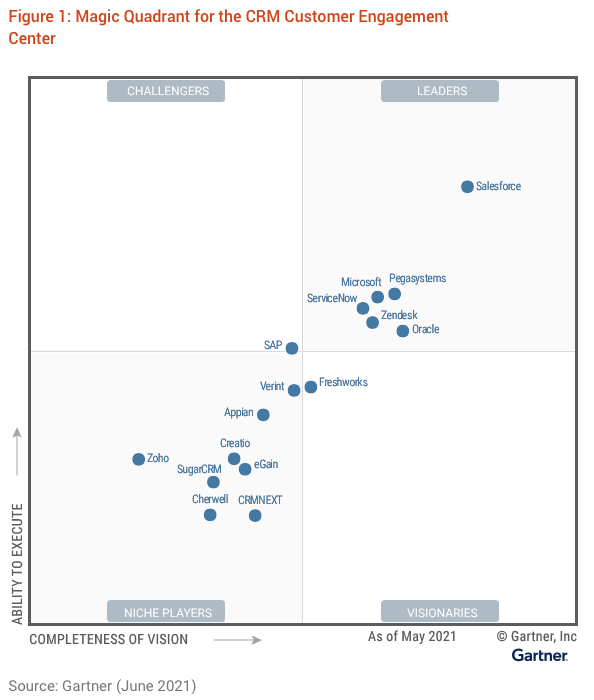
Gartner Magic Quadrant “CRM Customer Engagement Centre” (June 2021)

Gartner has recently published it’s Magic Quadrant for the CRM Customer Engagement Center (see here) with some interesting insight on the best technology platforms and software applications for the Customer Service and Support market.

Among the 6 leaders are the stronger players in the market with Salesforce leading the pack by some margin, followed by Pegasystems, Microsoft, ServiceNow, Zendesk, and Oracle.

Some interesting insights or comments from Gartner:

Salesforce Service Cloud

+ The continued investment in verticals by extending industry-specific offering. Be it by developing the product or acquiring other software solutions / companies.

Customers are showing concerns about high prices and contract inflexibility, as well as over-customisation of the platform.

Pegasystems Pega Customer Service

+ Praise is given to Pegasystems for its partnership and commitment to its customers’ digital transformation projects.

Customers flag that it’s very hard to find Pegasystems specialists, with relevant technical and industry experience, making it difficult to implement, develop and maintain.

Microsoft Dynamics 365

+ Customers highlighted the extensibility using the same codebase as the low-code Power Platform that underpins all Dynamics products and Microsoft-related systems.

Customers feel that they need a lot of training and support if they want to make the most out of the applications features and functionalities.

ServiceNow Customer Service Management

+ Gartner praises ServiceNow for its robust platform and capabilities around IT service management, asset management and real-time monitoring.

Customers complain about the complex and confusing licensing model, as well as the need to contract professional developers to configure and develop the platform.

Oracle Service Cloud

+ The report highlighted the features of OIA (fka Oracle Policy Automation), which enables some very clever self-service capabilities, when integrated with Service Cloud.

Customer’s continue disliking Oracle’s complex licensing model, as well as the time they need to skill-up, in order to develop, support and manage the software.

Zendesk for Service

+ Customers give a lot of praise to Zendesk’s innovation and ease of use, configuration, customisation. As well as for the agility, benefits and time to value.

Gartner states that, compared to some of the competition, Zendesk has limited vertical product strategy, which may hinder companies in certain regulated industries.

When it comes to Experience, Technology is a box-to-box

Technology has been an enabler for great customers and employee experiences for a long time, making it possible for companies to deliver fantastic messages, good services and personalised experiences.

But as Experience is now the biggest differentiator between companies (surpassing Product and Price), Technology is starting to become the biggest differentiator between experiences (many times surpassing Strategy and Delivery).

Truth is, Technology is the number 8 in your football team. In England they call it “box-to-box“. In other countries they call it the “one who carries the piano“. It’s not often the one that stands out, despite being the one that works the hardest for others to shine.

This blog was triggered by a conversation with a friend: “Well, to be honest it’s hard to believe it when you actually don’t see it. So, could you give me an example of how technology works in the background to enable great experiences?

I had just been on a call with a colleague and a customer a few days earlier, talking about a handful of ways they could use the technology stack they have to deliver great experiences. One of them related to the delivery of multi-language support.

Here is a scenario: You are a global company, selling all over the world. You have customers contacting and expecting you to support them in their own language. But your contact centre is in the UK, and your agents can only support in English language.

The easier solution usually requires the agent to perform 9 steps. Copy message; go to Google Translate; paste message; read translation; pray that it makes sense; draft response; copy from Google translate; go to original system; paste message.

To deliver a better customer experience, adding convenience of multi-language support, you end up hurting the employee experience, adding a huge effort to the agent. Alternative? Hire agents with language skills, which will bring additional cost.

Well, this is a very good example where Technology can help. Here is an easy solution – interface your contact centre technology platform with AWS and leverage the power of Amazon Web Services.

  1. Send customer’s message to AWS, via AWS EventBridge
  2. AWS EventBridge will send the message to AWS Lambda
  3. AWS Lambda will in turn send the message to AWS Translate
  4. AWS Translate will translate the message and send it back to AWS Lambda
  5. AWS Lambda will interface and send translated message to your agent

This all happens in real-time, meaning it would only take fractions of a second for your agent to have the translated message available to read, and respond to the customer. Do you have other use cases or want more?

Simple, in step 3 replace AWS Translate for AWS Comprehend and offer agents the sentiment of the customer’s message. Or replace AWS Translate for AWS Lex to read customer’s intent and respond accordingly.

These are just a few examples of how Technology can do some magic in the background. Allowing you to deliver convenient, personalised and outstanding customer experiences. Avoiding impact on agents will also make them feel empowered and offer a much better employee experience.

And you do all that, while managing your operation’s costs, as well as leveraging the power of your technology investments.


Note: Below is an example of one of the solutions, using Zendesk and AWS

Enabling B2B global customer support

In the CX community this is not news. When it comes to Customer Experience, our expectations are set by the interactions we have with companies like Amazon and Apple (companies on the B2C – Business to Consumer market).

When at work, dealing with other companies (in B2B – Business to Business scenarios), we also expect the same level of service, the same smooth and simple Customer Experiences, the same innovation and type of engagement.

I’m lucky to work with companies in both spaces. One of the B2B companies I work with is Sandvik – a global high-tech and engineering company founded in Sweden in 1862, with 40,000 employees and presence in 160 countries.

My team at Capventis had the pleasure to work with their Global Technical Support Team (for Mobile Mining & Rock Technology), enabling Zendesk – and it’s Support, Chat, Talk, Guide products – to allow them to provide seamless, effortless, convenient omni-channel support to their customers.

The video above shows Sandvik introducing the new Digital Helpdesk in a mission “To provide world leading customer service through a remote 24-hour technical support desk

Note: Sandvik are specialist in “Tools and systems for industrial metal-cutting; Equipment and tools, service and technical solutions for the mining and construction industries; Advanced stainless steels and special alloys as well as products for industrial heating“.

“Fast-Forward” on Retail Experience

shopping_Right-2-512

The COVID-19 pandemic will have a “fast-forward” effect on certain things, namely in the way we shop with retailers. The transformation was already in progress, but will now happen faster than expected.

Many consumers, particularly in the biggest cities, already shop mostly online and have orders delivered by retailers at home – groceries, clothing, electronics, furniture, etc. The pandemic forced most consumers to do the same.

Some consumers suddenly realised that you can actually do shopping online, having the same offering. Others realised how secure and comfortable it is. Others even noticed how effortless and seamless it can be.

On the retailers side, those who thought it would be hard, and procrastinated their journey to be on-line, finally adopted technology, subscribed to e-commerce platforms (like Shopify) and are now in a much better position to compete.

Opening an online operation, allowing consumers to buy from “distance” also required a customer service setup. Again, many retailers accelerated the adoption of multi-channel customer interaction technology (like Zendesk).

The way we shop, will surely change for good. Going forward, consumers will shop much more online (accelerating the trend of the last decade) and only go to brick & mortar shops when the need exceeds “shopping”.

What I mean is… many people go out shopping (in malls, etc.) not only because they need to buy something, but because they are looking for social interaction and distraction, with family or friends.

This is not news, and that is exactly why malls and retail parks started opening restaurants, cinemas, bowling alleys, entertainment venues for kids, etc. People go there not only (sometimes not even) to buy stuff, but rather to socialise.

The same will now apply to the wider industry – big, medium and small retailers. Meaning everyone will have to do something to attract people to their shops. Of course not all can or have size to build cinemas, so they will have to build Experiences.

Big successful retailers are already pioneering this. Apple designed all their shops with a focus on customer’s experiences. Offering a modern and innovative environment, that unlocks creativity, inspires learning, and encourages connections.

But how do you know what “experiences” will attract customers? Once more, technology can help. Experience management platforms (like Qualtrics) allow companies to reach out and understand customers’ needs, wants, drivers.

That insight can then be turned into action to baseline experiences and improve continuously.

Customer Experience in Water Companies

affinity_water

In England and Wales, OFWAT (part of the Department for Environment, Food and Rural Affairs) is the authority that regulates the water and sewerage industry, after services started being provided by private companies, to residential consumers.

A year ago OFWAT issued PR19 (Price Review 19) a comprehensive and stringent report about the way the water industry operates in these countries. And on the back of that, replaced SIM (Service Improvement Mechanism, launched in 2010) for C-MEX.

C-MEX stands for Customer Experience Measurement and is the mechanism OFWAT found to incentivise water companies to become customer-centric and deliver good experiences. Until 2020 incentives would be reputational, and thereafter financial.

But water is a commodity and customers don’t have a choice of supplier. We must use the incumbent in our area. Majority of us don’t even interact with our water company, and a significant subset of us pay bills via direct debit, without even looking.

So how can water companies engage with customers, from a CX perspective? From my point of view there are a couple of things that matter and impact customer’s satisfaction with a water supplier: Brand perception and customer service.

Of course we would like water suppliers to ensure service doesn’t have issues (e.g. leaks, disruptions), that bills are clear, and prices fair. But a new generation also wants companies to care about the planet, and how water is used (or wasted) – see good example in email I received from my supplier (Affinity Water).

When we contact our water supplier (statistic says mostly to complain/report issues) we want empathetic, seamless and efficient interactions. Actually, one of the drivers in C-MEX is complaints handling (and definition of “complaint” includes those made via social media – in line with Consumer Council for Water’s definition).

Another interesting guideline from PR19 is that water companies will need to offer at least 5 communication channels for receiving contacts and complaints. Phone, email, and post seem the obvious ones being used.

Water companies will need to start looking at the enablement of channels like Live Chat, Social Media, and Text Messaging (e.g. WhatsApp), to comply with the 5 channels rule. OFWAT says penalties will apply, if they don’t.

Technology can definitely help water companies comply with PR19, and ensure they follow C-MEX guidelines.

  • An omni-channel ticket/case management platform (like Zendesk) can enable the required multi-channel capability for interaction and complaint management.
  • An experience management platform (like Qualtrics) can enable the required C-MEX capability to measure consumer experience with NPS and CSAT.

Reduce backlog and improve productivity with “Bump-Bump-Solve”

In a time where customer service and support teams are being flooded with queries and requests, it is important that technology helps not only improve productivity, but also the experience delivered.

Examples like the one below allow technology platforms like Zendesk to take care of repetitive tasks, automating where possible, and freeing up customer service for key customer interactions and conversations.

This demo and video was built and recorded by my colleague Matt Brown – Senior Consultant at Capventis, with 15 years experience in Support Management, and leading the Zendesk enablement and implementation for our customers.

5 Essentials for CC Agents working from home

c0481846-wuhan_novel_coronavirus_illustration-spl

The COVID-19 outbreak in Europe continues to spread, and it seems some countries have not seen the worst of it yet. However, businesses are already being impacted massively.

Some of the biggest impacts have happened in the Customer Service or Customer Care area, with many people trying to contact companies to ask for help – making contact centres very busy and stretched.

More than adding people to their contact centres (I heard some companies are adding thousands of agents) the challenge is to ensure they have all they need to work efficiently from their homes (no one is even remotely thinking of having hundreds of agents in an open-space now!)

What do companies need to provide agents, so they can work from home, without impacting the service delivery and customer experience?

  1. Laptop – most contact centres still equip agents with desktops, and it is critical that all agents have a laptop they can take home.
  2. Headset – a good headset (noise-cancelling, etc.) to ensure the kids screaming or the dog barking in the background doesn’t impact the call quality.
  3. Connection – not all agents will live in an area with fibre, so might as well cater for the faults of a wi-fi connection, with an Ethernet cable.
  4. Security – the majority of companies will have their systems (even if cloud) behind firewalls and only accessible from outside via VPN, so configure those.
  5. Collaboration – agents will no longer be able to turn to their colleagues, or tap them in the back for help. So ensure they can have “offline” conversations.

Of course this all assumes you have a SaaS platform (cloud and web-based), that your agents can access, to manage and log customer interactions – what we would call a customer/service/ticketing management system.

If you don’t… then I would strongly recommend you look into Zendesk. I partner with them, and have helped many companies enable it. It is probably the quickest to subscribe, switch on and start using. And the easiest to adopt, as it is easy-to-use and user-friendly. Apart from that, it brings the necessary features to collaborate, take calls, etc. all in one app.

Closing the loop with Qualtrics and Zendesk

Bill Gates has a famous quote “Your most unhappy customers are your greatest source of learning“. He was spot on. Gathering feedback from customers, in particular those who are not quite satisfied, is crucial for any business.

It is extremely important to use that information to improve products or services, but even more important to close the loop with the customer.

Most businesses send transactional CSAT surveys to customers, after interactions. And then digest, analyse and act on the feedback provided. But many still fail to come back to customers, leaving them to think they were ignored.

Technology can be the enabler, and this video shows how it can be done, using two of the most powerful technologies platforms in the market. On one side, Qualtrics (the XM platfom) and on the other Zendesk (the Customer Service platform), working seamlessly together.

In the scenario shown in the video, a customer receives and responds to a (Qualtrics) CSAT survey. It’s response automatically creates a (Zendesk) ticket, allowing the customer care team to close the loop.

P.S. – This demo was created by the Capventis team (Lydia Castano, Sergiu Ardelean, Adrian Remedios)