Customer Experience in Water Companies

In England and Wales, OFWAT (part of the Department for Environment, Food and Rural Affairs) is the authority that regulates the water and sewerage industry, after services started being provided by private companies, to residential consumers.
A year ago OFWAT issued PR19 (Price Review 19) a comprehensive and stringent report about the way the water industry operates in these countries. And on the back of that, replaced SIM (Service Improvement Mechanism, launched in 2010) for C-MEX.
C-MEX stands for Customer Experience Measurement and is the mechanism OFWAT found to incentivise water companies to become customer-centric and deliver good experiences. Until 2020 incentives would be reputational, and thereafter financial.
But water is a commodity and customers don’t have a choice of supplier. We must use the incumbent in our area. Majority of us don’t even interact with our water company, and a significant subset of us pay bills via direct debit, without even looking.
So how can water companies engage with customers, from a CX perspective? From my point of view there are a couple of things that matter and impact customer’s satisfaction with a water supplier: Brand perception and customer service.
Of course we would like water suppliers to ensure service doesn’t have issues (e.g. leaks, disruptions), that bills are clear, and prices fair. But a new generation also wants companies to care about the planet, and how water is used (or wasted) – see good example in email I received from my supplier (Affinity Water).
When we contact our water supplier (statistic says mostly to complain/report issues) we want empathetic, seamless and efficient interactions. Actually, one of the drivers in C-MEX is complaints handling (and definition of “complaint” includes those made via social media – in line with Consumer Council for Water’s definition).
Another interesting guideline from PR19 is that water companies will need to offer at least 5 communication channels for receiving contacts and complaints. Phone, email, and post seem the obvious ones being used.
Water companies will need to start looking at the enablement of channels like Live Chat, Social Media, and Text Messaging (e.g. WhatsApp), to comply with the 5 channels rule. OFWAT says penalties will apply, if they don’t.
Technology can definitely help water companies comply with PR19, and ensure they follow C-MEX guidelines.
Technical mastery is not enough to be competent

On “Consultancy lesson from Winston Wolfe” I talked about how consultants are not, and should not try to be “must-know-it-all encyclopedias with a solution for everything” that “are available within the hour” and “make problems go away in no time“.
Another crucial principle that consultants should always follow is that technical mastery of their specialist discipline is not enough to come across competent, and deliver good service and/or advice to a client. You need to earn their trust and confidence.
To do that, consultants must value the relationship with the client, more than the transaction in hand. However big it may be, it could be the only one you get, in case you are not able to create a long-standing and trusted relationship with your client.
Consultants invest in improving specialist technical skills, focus on acquiring experience, and work hard on building a network of contacts. But rarely spare enough time creating and nurturing trust relationships with clients. Majority don’t even know how to do it.
Here are a number of things you should follow if you want to build trust and confidence:
- Focus more on the client (and the problem), less on yourself (and your skills)
- See your client as a person (John Smith), and not just a role (Head of Operations)
- Listen more (understand challenge and concerns), talk less (don’t assume)
- Do the right thing (for your customer), not what’s best for you
- Personalise your delivery, don’t give “blanket” answers or on-size-fits-all solutions
- Be honest and transparent (even if truth is hard), don’t hide issues or say it’s all easy
- Make yourself always available, accessible and reachable
Customer-centricity, humanity, integrity, reliability, dependability, responsiveness (among other characteristics) are, more often than not, more important than technical mastery, when it comes to deliver outstanding service and successful outcomes to clients, creating long-standing win-win trust relationships.
Gestures that turn customers into advocates
This week I received an email from the company where I have my car insurance – Admiral – and the subject was “Important information about your Admiral policy”.
Past experience tells customers that an email with this subject rarely brings good news. It usually is to inform that premiums went up, or something of that nature.
But the content of the email was rather surprising. Admiral was telling me that due to COVID-19, and the lock-down measures, there was less cars on the road.
This obviously resulted in fewer claims. So Admiral decided to pro-actively issue premium refunds to their customers. How cool is that?!

There are a lot of great things about this gesture of goodwill, as well as the way it was communicated, delivering an outstanding Customer Experience.
- The gesture is not common in the industry; Surprises the customer with good news in a time of crisis; And puts some money in the pockets of some customers in need.
- It shows that even in during a crisis, and whilst the company is dealing with enormous challenges, they are still thinking of the customer.
- The communication is personalised, direct, simple and to the point; It not only says how much will be refunded, but is transparent re. the calculation done.
- To avoid confusion, anxiety or frustration, it also clarifies how it will be done; And when the customer can expect the refund.
- For customers who may need further information, a landing page was created admiral.com/stayathome where it is also easy to get in touch.
I have researched a lot when looking for a car insurance, and one of my criteria was Customer Experience – it seems like Admiral is living up to the positive reviews and brand promises.
I am a loyal customer that, on the back of this experience, turned into an advocate.
Doctor CX – CX Books – Episode 12
Doctor CX – CX Books – Episode 11
Your technology selection approach is broken!
When it comes to choose and buy technology to enable business outcomes, far too many companies still use the same approach of consulting analyst reports, building and issuing RFx, going through long selection and purchasing cycles.
This approach is broken. It is a waste of people’s time and effort, as well as businesses’ money. And, more often than not, it doesn’t provide the desired outcome: the smooth implementation and adoption of a technology that is fit for purpose.
It worked well when technology pricing and licensing models were expensive, required a huge investment in infra-structure, and demanded implementation cycles of many months (sometimes even years). That is history!
Today’s technology platforms pricing and subscription model derisks decisions. Businesses can select a technology; subscribe to it for a very small amount of money and period of time; implement it in a matter of weeks; and prove or disprove its value and adoption.
G2 was created to help change the paradigm, and move the technology selection process to the 21st century – by allowing “real” people to review the technology platforms, rather than just leaving that to a select group of “biased” analysts.
I have said it more than once. What works for consumers must work for companies as well. Purchasing business technology should be as easy and effortless for company’s decision makers, as buying consumer products or services is for all of us.
That is also why G2 came to play a crucial role. It provides “unfiltered reviews” from people who actually use the technology solutions or platforms. More than that, G2 made it simple, clear and easy to navigate and understand, leaving behind jargon.
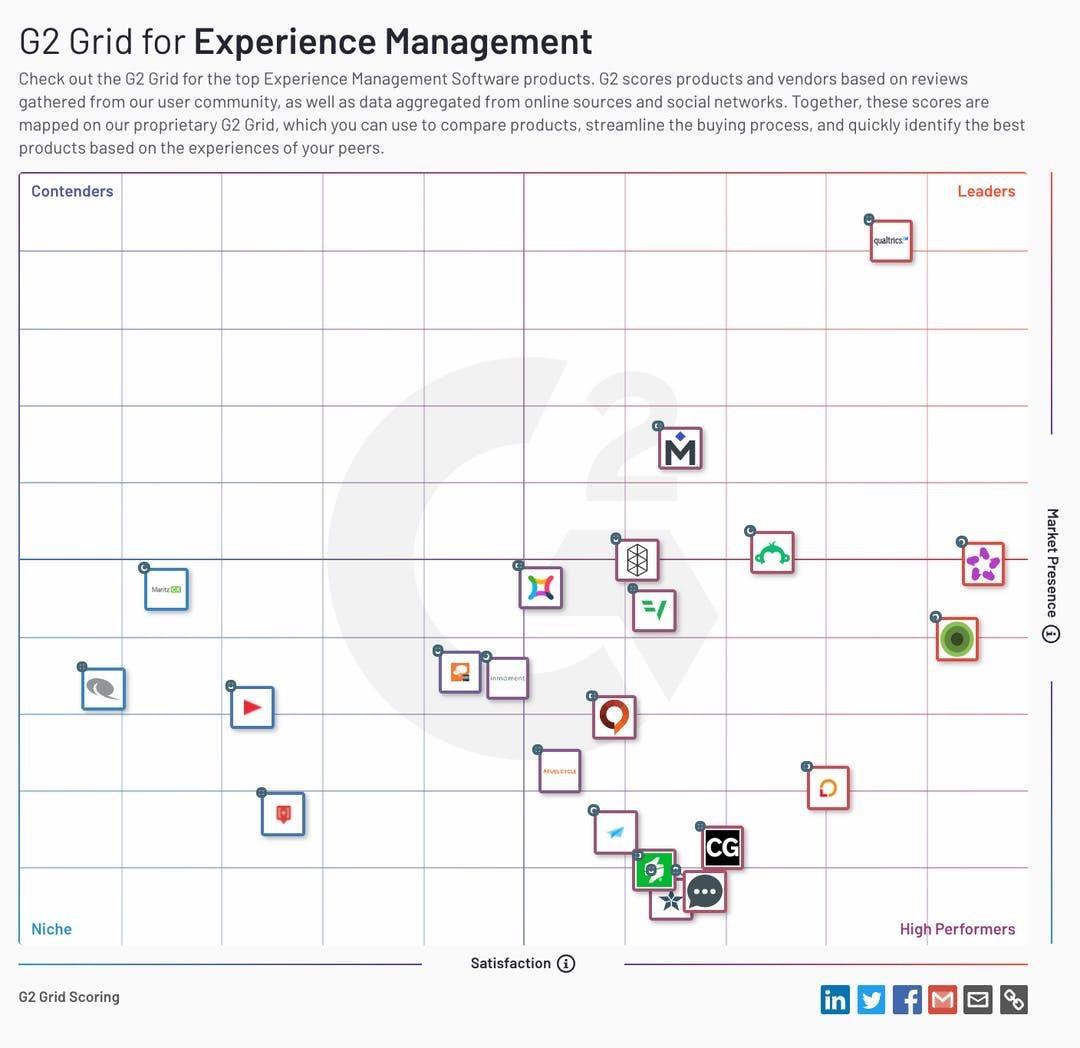
Furthermore, it innovated! And this post is also to praise them for the creation of the category that looks into Experience Management Software products – where we see Qualtrics (miles away from competition) and Medallia in the Leaders quadrant.
Doctor CX – CX Books – Episode 10
Employee Engagement and Technology after COVID-19

The world evolves every day, but some events make certain changes come abruptly. In the 20th century, things were never the same after the second World War. And no doubt things will change for good now, after this COVID-19 pandemic.
One of the things that will change is the way we work, and where we work from. Many companies will realise that they no longer need to pay whopping rents for offices in the centre of capital cities, as people can be as efficient working remotely.
But if the cost saving will be good news for companies, and the avoidance of daily commutes will please employees, the situation will pose some challenges, namely around two key things: employee engagement and technology.
1. Employee Engagement
The experience of working for a company will be completely different if people work remotely and don’t have much face-time – for internal meetings, client workshops, even coffee-breaks or team building activities.
In a not completely unlikely situation, people could even spend their whole tenure at a company without physically meeting their colleagues. We see today, many people being interviewed and hired over video-conference.
So the paradigm for Employee Engagement needs to change. HR and XM specialists will be asked by companies to come up with different ways of getting their employees to “feel the company”, “live the culture” and “wear the jersey“.
This will impact the strategy, approach, and tactics used in current Employee Experience programs – be it lifecyle (e.g. on-boarding, exit), 360, or pulses. And technology will play an even bigger role in the enablement of this.
2. Technology
But if things change the way we envisage, and more companies and people adopt remote work, technology will no longer be just an enabler (something that makes it possible for a particular thing to happen or be done), it will be pivotal.
Employees will not be able to do their work without technology – I’m thinking not only of Software but also of Hardware. And this will demand technology companies to develop their platforms and devices even further, making them more powerful.
What we achieved, technology-wise, in the last 2 decades (since the Personal Computer and the World Wide Web got married) is absolutely astonishing. With that, remote working today wasn’t possible. But technology is only developing at a possible pace.
The expectation is that this crisis and the changes that will come as a consequence of it, will give a gigantic push for technology development to accelerate massively, and for its power to become unthinkable… but necessary to cope with the new normal.
How COVID-19 will change restaurant experience
The world will definitely not be the same after this COVID-19 pandemic, and many aspects of our daily lives – even those that seem trivial – will be impacted. Some of them changed for good and, I will argue, also for the better.
Recent interactions with a good friend – Miguel Cizeron, an experienced Chef who is opening a new Restaurant in Portugal – made me think of something everyone experiences and will definitely change soon: going out for a meal with friends or family.
Every time we go out for a meal, we are looking for a enjoyable experience. Either we go to McDonald’s with our kids, expecting to see them happy and having fun. Or we go to a fancy restaurant with friends, for a pleasurable and unique experience.
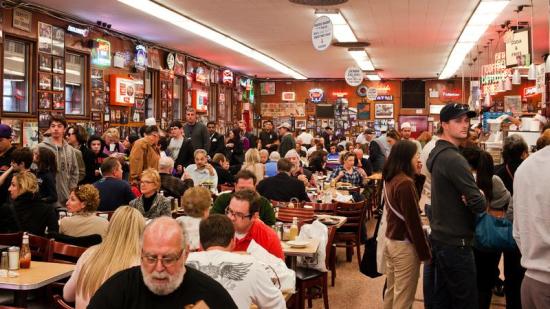
But many times the experience is below par. The food is great (every McDonald’s has tasty burgers and chips, and all fancy restaurants have delicious dishes) but the experience is so much more than food – it’s the the ambiance, the service, the people around us.
More often than desirable, one of those things ruins the overall experience. You wait before getting seated; there’s so much noise that you need to shout for others to hear; people next to you hear your conversation; staff struggles with so many orders.
The social distancing measures that will need to be put in place, due to the pandemic, will most probably change a dinning experience. And, as far as I’m concerned (I hate crowded places), it will change it for the better.
We don’t know yet what governments and policies will enforce, and what the regulations will look like. But surely people will have to make reservations and arrive on time, avoiding queues and people waiting in cramped entrances.
Restaurants will have to reduce capacity, increasing distance between tables. This means customers will be much more comfortable. There won’t be too much noise, people can have private conversations, staff will be more attentive, etc.
My Chef friend asked a good question: “If restaurants reduce capacity, they’ll probably have to increase prices”. My answer, based on public research, is “No problem” – because most people (like me) will gladly pay more for a more enjoyable experience.
 Doctor CX