Oracle Service Cloud 2018 All-Star

stzJOmI

It was we great honour and delight that I received the news. For the second year running, Oracle has named me “Oracle Service Cloud 2018 All-Star“, for my expertise and being one of the leaders within the Oracle Service Cloud community, but above all for being willing to share my knowledge.

I’m again part of a fantastic group of people that use this great technology platform to enable better customer service and customer experiences. I’m very thankful to Erica Anderson, who is the main driving force behind this fantastic community.

Read full blog and list of 2018 All-Stars here: http://communities.rightnow.com/posts/751f0f02ee?

Break the fourth wall to improve survey experience

Organisations launch surveys to measure customer experiences, but is the survey itself delivering a good experience? Those of us who usually take the time to provide an organisation with feedback on our experiences, know that the answer to that question is more often than not a resounding “No”.

The problem is that most organisations are just throwing surveys at customers without any consideration. Ultimately resulting in surveys that put people off, and customers disbelieving organisation’s intentions, thinking they just want to get more information to cross/up-sell.

If your organisation wants to be customer-centric and is truly interested in the customer opinion, then there are a few things to concentrate on when building Voice-of-Customer initiatives. One of them, which I believe is absolutely key, is Personalisation, and it can be addressed by breaking the fourth wall.

Design your surveys with an outside-in perspective, with a big focus on the customer. The one you are talking to, not a generic customer, persona or segment. Do what Frank Underwood used to do in House of Cards. Break the fourth wall and talk to the individual customer about what is relevant to her.

You have a full history of transactions and engagements in your operational systems (ERP, CRM, etc.) so why ask the customer what product she bought, before requesting feedback? Why ask the customer what channel she used, before checking if it was the most convenient. Ask the customer about THE product she bought or THE channel she used.

Make sure you use all information and data at your disposal – Operational Data (O-Data) and eXperience Data (X-Data) – to make surveys more personalised, simpler and effortless for the customer. This will ensure not only a great survey experience but also an increase in response rate.

The customer will not only feel valued, but also feel that the organisation is listening and willing to truly consider their opinion (closing the loop is another crucial topic that influences this, but we will address that in another blog post). 

Do you want an example?… See these two surveys below. Which survey sounds better? Which sounds more truthful? Which is more attractive? Which is going to generate more responses?… It is obvious, isn’t it?

surveys2

CX Technology, Status and Vision

In a recent and extremely insightful webinar, Gartner shared a few very interesting findings, that show company’s approaches when it comes to investing in technology to support or enable the delivery of (what they hope will be) superior customer experience.

Gartner says that in 2018…

Improved customer experience and loyalty is the top outcome for digital business transformation.

In a survey to CEOs, the answer to the question “What are the top three outcomes your organization has already realized as a result of its digital business transformation?“, almost half of responses mentioned improved interactions, thus loyalty with customers, and improved customer experience.

More than 80% of client calls to Gartner about CRM and CX applications are focused on a specific business requirement for one department, and tend not to have the whole enterprise in scope.

Most of the market leading vendors claim to have a fully integrated CX platform, that can help companies deliver a seamless customer experience. But the truth is those platforms are a mix of various applications – in some cases even built in different technologies.

Different applications for eCommerce, Marketing, Sales, Customer Service, Field Service, Content, etc. that aren’t joined up, don’t share channels (email, chat, web, phone, social) or analytics, and don’t have out-of-the-box connectors to each other, thus require integration efforts.

That is not necessarily a bad thing. Gartner actually states that “No transformational customer experience or CRM initiative succeeds using only one application“. Best-of-breed solutions for the various areas have been developed and built by different technology vendors. What companies need to do is make sure they take a holistic view when architecting their customer engagement hubs.

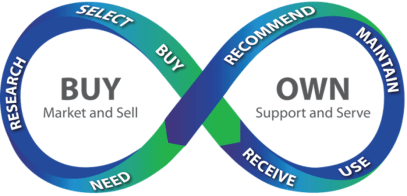
An estimated 50% of organizations are still thinking of the customer life cycle from an inside-out perspective – focusing on the idea of selling and service cycles, rather than buying and ownership cycles.

Changing technology platforms is always easier than changing a company’s culture or people’s minds. Despite most companies, in particular their CxO’s, are saying that improving customer experience is their main priority, the transformation is attempted with people that struggle to change their mindset.

The famous quote suits like a glove: “Insanity is doing the same thing over and over again and expecting different results“.
20140725 CX Infinite Loop

At Capventis, the company I work for, we re-designed the CX infinity loop, where “Buy” and “Own” (the customer’s perspective) stand out and are the main focus. Whereas “Market and Sell” or “Support and Serve” (the company’s perspective) is secondary, recognizing nonetheless its importance and impact on customer experience.

Customer Analytics is the top technology for CX investment. By 2020, more than 40% of all data analytics projects will relate to an aspect of customer experience.

Following what we have been saying at Capventis, in this more demanding and ever more sophisticated digital world, Experience is the driver, but Information is the ingredient.

Information, data, analytics are becoming absolutely crucial for the delivery of great customer experience, playing a key role in various areas. Some of which are…

  • Measure customer experiences
  • Blend operational (O-data) and experience (X-data) customer data
  • Prioritise improvements on the customer journey
  • Enable real-time personalised interactions
  • Deliver artificial intelligence and allow machine learning

A Shift will have to happen: Data-Driven Systems to Event-Driven Systems.

Companies are data-driven, and still prioritise the preservation of data, which is the source of truth, and they deliver experiences on the back of the data they’ve collected. Gartner envisions that in the next few years, companies will have to become event-driven, where the priority is reacting to events. According to Gartner, the key components of an event-driven system are:

  • Situational Awareness – Event visibility and context over customer journey
  • Customer Intelligence – Event-driven recommendations and CRM capabilities
  • Real-Time Orchestration – Automate, act and achieve customer experience
Social Media Customer Engagements: 4 Challenges, 7 Segments

Social-Media.jpg

Social Media is no longer something that can be overlooked by companies. And presence in social networks is not enough. Customers are not just expecting but demanding that companies engage with them via Facebook, Twitter, etc. But companies still struggle to manage those channels and find it very difficult to manage the volume and type of interaction.

Some pioneer companies and social media specialists have been doing it for a while. And it is definitely worth looking into what they are doing, and adopting similar strategies and approaches, to address the different challenges.

  1. Which messages are actually worth responding to?
  2. Could those messages be segmented in some way?
  3. To whom should those messages by assigned to?
  4. Where can responses be composed and recorded?

I would advise companies to respond to as many messages as possible, negative and positive. To definitely segment them by type, in order to assign them to the team or person that can provide the best (or more accurate) response. Here is a good approach (from Symantec):

  1. Request: customer is requesting help to resolve an technical issue. These should be assigned to the Technical Team, for them to troubleshoot and respond, as soon as possible (ideally within the hour).
  2. Question: customer is asking a question, that is not necessarily pressing but needs an informative answer. These should be assigned to the Support Team, for them to provide the right answer (possibly in a knowledge-base).
  3. Abuse: customer is insulting your company, and may have a basis for doing it. These should be assigned to the PR Team, for them to assess and take any necessary brand protection actions.
  4. Praise: customer is praising your company, after a wow moment. These should be assigned to Marketing Team, for them to take the opportunity to leverage the advocate customer and her story.
  5. Lead: customer is hinting that he may switch from competition or considering buying from your company. These should be assigned to the Sales Team, for them to follow-up and convert the opportunity.
  6. Suggestion: customer is requesting a product enhancement. These should be assigned to the Product Management Team, for them to consider if it is worth to add to the roadmap.
  7. Fraud: customer is engaging with an unauthorized provider of your product. These should be assigned to the Legal Team, for them to follow-up with official and/or legal action.

Finally I would suggest all engagements take place in, and from, the Customer Management (aka CRM) platform, or alternatively from a social media management and engagement platform, that can easily be integrated with the CRM, so that your company can enrich the customer record, creating a full and complete view that will help and support future engagements and initiatives.

Opportunity Management and Add-ins in OSvC BUI

It was great news when Oracle announced the launch of the Oracle Service Cloud (OSvC) Browser User Interface (BUI), which finally gave more flexibility to the users and allowed them to access the platform from any browser.

Unfortunately, for reasons that do not make too much sense to me, Oracle decided to leave certain functionalities out of the BUI (functionality available in the Dynamic Agent Desktop – the .NET console). Opportunity Management was one of them.

The Opportunity Management functionality allows the management of sales opportunities, and is used by several organisations and thousands of users, who have in OSvC a full-blown customer relationship and engagement management platform.

That is the case in the company I work for, Capventis. We obviously wanted to adopt the BUI, but needed to have complete functionality. We decided to roll out to the service and support teams – as Customer and Incident Management is standard and available.

But then needed to roll out to the sales team, and therefore decided to create the Opportunity Management functionality (for the BUI) ourselves. In that process, we also decided to streamline the process of adding line items to Opportunities.

The truth is the standard Quote functionality never worked for us, and all we wanted was a simple way to add line items to an opportunity. We decided then to create what we called the Breakdown entity (with a Many-to-1 relationship with Opportunity).

This entity allows us to simply select the Type and Sub-Type of product or service to sell, add a Quantity and a Unit price to it. Then a BUI add-in automatically calculates the Total Amount for the line item.

The Opportunity entity is the same that we had (using the standard functionality), but another BUI add-in calculates the total amount of all line items (in the Breakdown entity) and automatically sets the opportunity Forecast Revenue.

Both BUI add-ins were put in place leveraging the BUI Extensibility Framework API which allowed us to develop the necessary JavaScript add-in and code to read and write data from and to the database.

The video shows the fantastic work of our team (in particular Harriet, Gary and Mark) who made it possible for everyone in the company to use the OSvC BUI, whilst making the Opportunity Management functionality even slicker and simpler.

My X4 Experience

img_3555.jpg

Qualtrics is definitely at the forefront in the Experience Management (XM) space, and the CEO (Ryan Smith) wants the Qualtrics XM platform to become the “system of record for Experience Management teams, practitioners and specialists“.

It was, therefore, no surprise that X4 Summit (Qualtrics annual conference, which took place two weeks ago in Salt Lake City, Utah) was absolutely fantastic. I had an outstanding experience, at all levels.

The venue was very good, located in downtown Salt Lake City, walking distance from hotels, restaurants, shops and pubs. The layout of the conference was well planned, making it easier to get around and find all you needed.

All staff (in particular the Dream Team) were incredible. The Qualtrics employees welcoming clients and partners, facilitating sessions and delivering hands-on workshops were excellent.

But above all, the speakers were absolutely outstanding. They delivered sterling sessions, sharing knowledge and invaluable insights, presenting what they have done in their organisations, enabled by Qualtrics.

Among these, were the keynote speakers, who delivered some astonishing and inspirational stories. Arianna Huffington, Alex Honnold, Tony Hawk or Magic Johnson, were some of my favourites. Ryan Smith, and his brother Jared, were also fantastic.

img_3540.jpg

I had the chance to attend, on behalf of Capventis, and was delighted to see it, among a strict list of 10 partners (worldwide), named by the CEO in his keynote speech, as a pioneer partner, in the Qualtrics Partner Network.

Qualtrics considers partners “expert with deep industry knowledge, experience, and insights” and states they were “carefully selected by for their unique domain expertise and XM offering” trusting them to give Qualtrics clients “world-class support”.

This was music to my ears, and a recognition of the work that our team has been doing in the last 2 years, helping organisations implement change and deliver better experiences, leveraging the power of the Qualtrics XM platform, and using it as an enabler.

Among those organisations are some that presented at X4 Summit, like Michelin or Allianz, who had some inspiring stories, innovative initiatives and simply great experiences to share with the audience that filled the breakout session rooms.

Seeing some of my fellow CXPA members and CCXP professionals, was also a highlight. As was taking the opportunity to do a couple of exams – in the Experience Basecamp – and attain two certifications (RC Core Expert and CX Expert).

For those who really love the XM platform, the highlight of the week was definitely when Ryan and Jared presented the new suite of IQ Products (by the way, it was the best technology demo I have seen in any software vendor conference).

The latest version of Qualtrics iQ brings the iQ Directory and Predict iQ to complement the already known Text iQ, Stats iQ and Driver iQ, creating “a set of advanced intelligent features built directly into the Qualtrics XM Platform. Powered by machine learning and artificial intelligence” and making “predictive intelligence and statistical analysis accessible for the rest of us”.

To supplement all of this great activity, Qualtrics put on an astonishing show in the evenings, for all the 7,000 attendees to network, socialise and have some fun. A Casino night, a skating performance by Tony Hawk (9 time gold medallist in X-Games), Andy McDonald (8 time gold medallist in X-Games) and a few others, a Maroon 5 concert in the final night, and a Ski Day in the final day of the conference.

Digital Experience Disillusion

digital-experience-documents-cloud-1440x959

There is an illusion, in the world of business, that makes companies believe that they’re innovating or ahead of the curve, in terms of delivering digital experiences, just because they’re investing in new digital platforms or channels – be it websites, kiosks, or mobile apps. I come across this almost on a daily basis. The truth is that those things alone won’t put your company at the forefront, or perform the so-called “digital transformation” in isolation.

If you want to deliver outstanding digital experiences, you need to understand that to engage customers digitally, you must do it in a way that is meaningful and personalised. And for that, it is absolutely crucial that you understand the human being on the other side of the screen. The values, principles, aspirations, preferences, and behaviours of the person that is interacting with your company.

Furthermore, you must do it in a way that is contextual, from two perspectives. Not only from a device or site perspective – because there is significant differences when it comes to deliver experiences on a website or a mobile app; on a laptop or a smartphone – but also from a cultural perspective – because people around the world have very distinct lifestyles, habits, customs and beliefs.

No company was able to get it right first time. Nor able to get it right at some point, and keep it unchangeable. And neither will you. It just doesn’t work that way. The world and the societies we live in, are mutable, constantly changing and developing. So it is extremely important that you put in place a program that allows you to continuously gather, research, monitor and improve your knowledge of your customers and their expectations.

That is precisely why it is key that you collect Experience Data (e.g. Voice-of-Customer, Voice-of-Employee). And then blend it with Operational Data (e.g. Orders, Transactions, Tickets). Analyse, make sense of the data, find trends/drivers, and deliver actionable insights. Which will allow you to design new and improved experiences, that you can then enable with digital platforms, and deliver via digital channels.

Oracle Service Cloud 18A release now available

The 18A release of Oracle Service Cloud (OSvC) is now generally available and it brings some great new features and enhancements.

Browser UI – Multi-Edit Workspaces

Multi-Edit Workspaces is a really basic but very useful functionality that was available in the Dynamic Agent Desktop (.NET Console) but still missing on the Browser User Interface (BUI). This release adds BUI support for Multi-Edit Workspaces for standard objects (Contacts, Organisations, Tasks, Answers, Assets) as well as custom objects.

This means that you are now able to update more than one record in a single operation instead of doing it on each individual record, saving you time when you need to make the same change to more than one record (e.g. updating Incident Status).

Knowledge Advanced – Product/Category Landing Pages

Customer Portal (CP) developers are now able to create product/category-specific pages. This will allow customers to select a product or a category and navigate their hierarchies using breadcrumbs and images. Additionally, any searches attempted from those pages will automatically use the selected product or category, and answers displayed will be specific to that product or category.

Knowledge Foundation – CKEditor for Answers

The Aug 17 release of OSvC announced a CKEditor for Community Self-Service. “The CKEditor is an open source text editor, written in JavaScript, designed to standardise text editors and features in web pages. And is widely used (…) giving customers a much better and improved text editor, when submitting questions or comments (…) Customers will have a WYSIWYG bar to edit text, ability to paste text from MS Word, and do custom HTML formatting”.

The CKEditor was only available in the BUI, but 18A release enabled it across both BUI and the Dynamic Agent Desktop (.NET Console), also for Answers.

Knowledge Foundation – Answers Versioning

Answer Versioning is a functionality that many users of OSvC, namely the knowledge managers, were (desperately!) requesting for a while. Almost 3,5 years ago I published a blog post to present Ideqa’s VersionCX – an add-in that allowed storing of historical versions of Answers.

18A release of OSvC finally includes this feature – even though it is only available in the the Dynamic Agent Desktop (.NET Console). Answer versioning will allow knowledge managers and authors to draft and publish versions of answers, compare versions and view historical, as well as live, versions of answers.

Platform – Bulk Delete API for Organisations

The Bulk Delete API was announced back in Feb 17 and Aug 17 releases, but was still not fully available. In the 18A release the Bulk Delete API supports Organisations and Accounts allowing you to purge accounts and organisations in bulk, using the API. Additionally, it allows the flexibility to delete selective data based on custom ROQL queries.

Platform – MySQL and PHP Upgrades

With the 18A release, OSvC will be upgraded to MySQL 5.7 from MySQL 5.1.

Additionally, a PHP upgrade has been performed for security compliance, from 5.6.18 to 5.6.31.

Configuration Settings – Tips VII

Oracle Service Cloud has circa 500 configuration settings, which control the platform’s functions. Some of them are commonly used but many are not that well known. Below are a few that you might want to be aware of.

AR_AUTO_ENABLE

This configuration setting is useful for knowledge managers or administrators to better manage the knowledge base, and ensure the answers are always up-to-date and helpful for customers.

It enables a feature that automatically changes the status of an answer to “Review”, when data aging reduces the answer’s solved count to zero. The default value is disabled (No) but you might want to turn it on (Yes).

ANS_NEW_INC_DURATION

Speaking about answers aging, this configuration setting specifies the number of days that the Solved Count of new answers will not be aged (meaning reduced).

You might new answers not to be impacted by aging, in the first few days or weeks, and ensure they keep up there for people to easily bump onto them.

If this value is set to zero (0) no answers will be considered new. The default value is 30. And the maximum is 9999999999 (basically, forever).

ANS_UPD_INC_DURATION

Similarly, this configuration setting specifies the number of days that the Solved Count of updated answers will not be aged.

If this value is set to zero (0) no answers will be considered new. The default value is 30. And the maximum is 9999999999 (basically, forever).

Please notice that this is for updated answers, whilst the above setting is for new answers.

ANS_PRV_ENABLED

If you would like to implement a specific answer access level, and have a subset of answers only to be seen/displayed to users with a specific access level, then you must enable this configuration setting.

It enables the “Privileged Access” feature which allows customers to access privileged access levels of answers. These access levels are in addition to those that are visible by default on the interface (Help, Everyone).

Privileged access levels are assigned to SLAs. An SLA must be applied to a Contact or Organisation and the individual must be logged in to the customer portal, in order to view the answer.

The default value is disabled (No), and you must enable it to allow privileged access (Yes).

OSvC_blog_accesslevel

ANS_SRCH_THRESHOLD

When a customer searches for an answer on the Oracle Service Cloud knowledge base, the system will weigh the answers, based on the search (keywords, etc.). This configuration setting specifies a threshold for returning answers.

Only answers that match at or above this threshold will be returned. The minimum and default value is zero (0) and the maximum is 2147483647, even though acceptable values are between zero (0) and 100.

If the configuration setting ANS_SRCH_SUB_THRESHOLD is enabled an exception is made when all matching answers are below the threshold.

ANS_SRCH_SUB_THRESHOLD

As mentioned above, this configuration setting is linked to ANS_SRCH_THRESHOLD and it specifies whether there should be an exception to limiting answer results with a threshold on matching.

If enabled, when no answers match at or above the threshold set, the answers that matched less well are still returned, avoiding a zero result set. If disabled, no answers matching below threshold are ever returned. By default this configuration setting is disabled (No).

Keep up with customer perceived value

To thrive in today’s hyper-competitive and hyper-connected customer-focused world, you must not only deliver a positive Customer Experience every time you interact with a customer, but also create, deliver and refresh value, as perceived by customers, on a continuous basis.

The Kano Model (theory of product development and customer satisfaction developed back in the 80’s) classifies customer requirements into categories, and can be used in experience management to help us understand how customers perceive the value they get.

  • Must-be or the unspoken customer requirements are so obvious that the customer doesn’t expect to have to spell them out. They’re the absolute minimum, and the customer won’t even notice if you meet them. But if you don’t, it will be so crucial that you should be prepared to lose a customer.
  • One-dimensional requirements are related to product features or elements of service delivery. The more of those you meet, the better the Customer Experience, and the highest the customer will think of you. If you fail to deliver them the customer will certainly be disappointed and open up to competition.
  • Delighter requirements are the ones that surprise the customer and will delight or even wow, having an extremely positive impact on the Customer Experience, leading to word-of-mouth and advocacy. But no harm is done if these aren’t there, as they are not expected anyway.

The interesting thing is that with time Delighter requirements become One-Dimensional, and One-Dimensional requirements become Must-be. And that is one of the reasons you need to continuously update your understanding of the customer, and their perception of value.

There is only a limited number of ways to increase your knowledge of the customer. Look into solicited and unsolicited feedback – two good examples of that are the voice-of-the-customer (VoC) from surveys, or the interaction and buying information from CRM systems.

But the challenge is: how quickly and effectively can you collect, gather, aggregate or analyse data, and find actionable insights that will allow you to enhance an individual’s Customer Experience with your company and its products or services?

You will definitely need to assemble a cross-functional team. As OVUM says “the twin engines of growth – Customer Experience and continuous innovation – are not departmental challenges, as they have implications for the entire enterprise, its ecosystem of partners and suppliers”.

And you will undoubtedly need technology to enable and support you. An agile technology platform, focused on experience management, which allows you to collect valuable information and data at every customer journey stage, and from every touch-point or channel.

A technology platform that allows you to incorporate customer knowledge and feedback into every decision, by offering powerful capabilities to analyse, prioritise and predict based on statistical, text or sentiment analysis. As well as allow tracking of progress and immediate action.

So, if you are trying to keep up with your customer’s perceived value make sure you surround yourself with the right people, gear yourself up with the right tools, and put in place a continuous improvement plan, that will certainly have a start date but no end date.