It’s official – Oracle TAP is gone!

Oracle_Service_Cloud_TAP_deprecated

There are a few posts in #DoctorCX about Oracle Service Cloud (OSvC) for mobile devices, the last one shared in Jan 2017. And lately there has been many people asking about it on the comment boxes. Mainly due to the fact that the Oracle Mobile Agent App (Oracle TAP) has suddenly disappeared from App Store and Google Play.

The truth is, as we suspected, it was discontinued. It is now official, and Oracle announced it, that from May 2017 release Oracle TAP is deprecated. However, Oracle will still leave it available for at least 2 years before the removal of the functionality.

The main reason Oracle is giving for the deprecation of Oracle TAP is that it “doesn’t meet customer needs due to the limited availability on iOS and the lack of extensibility and configurability“… and, in all honesty, I agree. Even though it was an easy way to provide mobile capability out-of-the-box.

The recommendation or suggestion for customers who are using it, or for those who are looking for a mobile interface, is to start using the Agent Browser UI (which will only really render well in tablets) or use the Mobile Accelerators to build their own mobile apps.

The Mobile Accelerator is based in the principle that the customer, or a specialist partner, would develop a mobile app using the Oracle Mobile Application Framework (MAF), which is a Java/HTML5-based framework, that allows developers to create apps for Apple iOS and Google Android devices from a single code base.

May 2017 release now available

The May 2017 release of Oracle Service Cloud (OSvC) is now generally available and, as always, brings some exciting new features and functionality that touch the Customer Portal (CP), the Browser UI (BUI), the Knowledge Base (KB), Oracle Policy Automation (OPA), and the underlying platform.

Community Home Page and Widgets

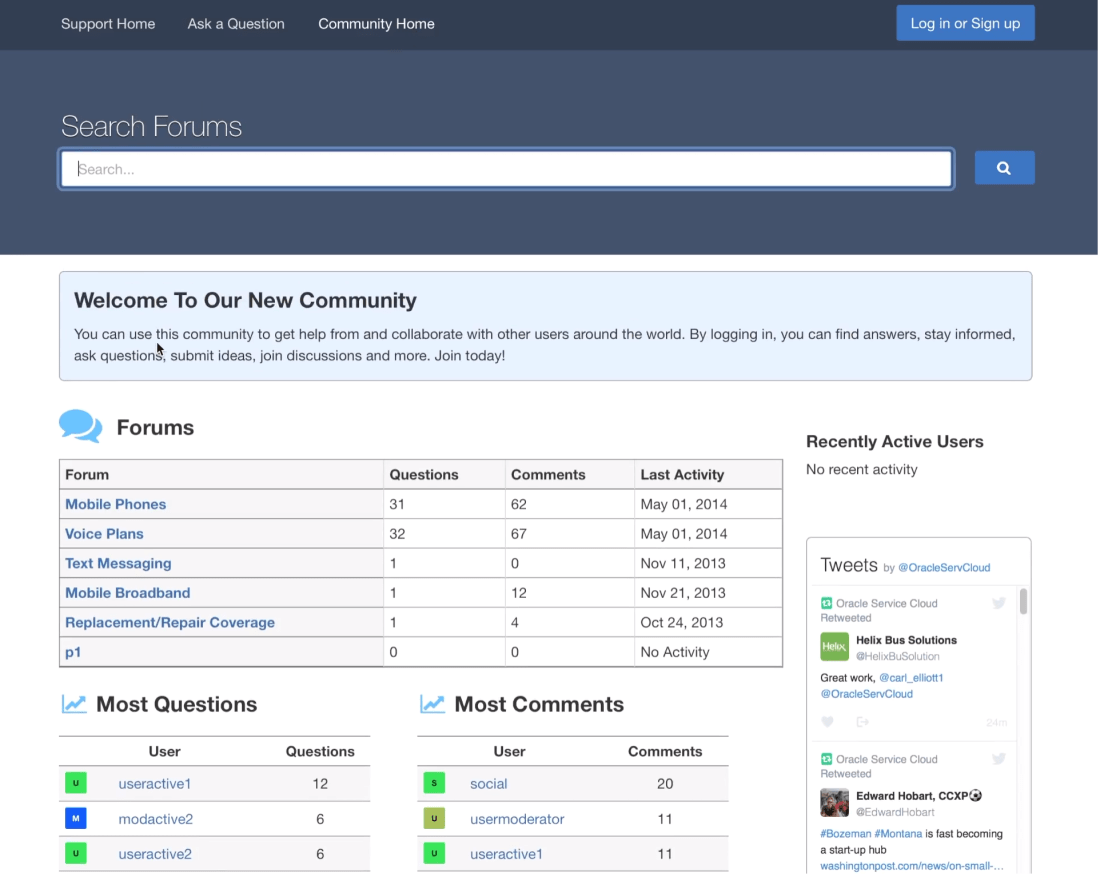
A “Home Page” is now available for the community, acting as the landing page and facilitating – through a series of new (and existing) widgets – an immediate overview. It also provides an easy navigation to the areas of the community that are most relevant to the customer, making things more user friendly and smooth. Some of the new widgets (listed below) are shown in the following screenshot.

  • Announcements
  • Forums List
  • User List (most comments)
  • User List (most questions)
  • Recently Active Users
  • Twitter

This new release also includes other new features on the discussion and account management pages, as well as allows community members to use Facebook profile picture as community avatar.

Oracle_Service_Cloud_Community_New_Widgets2

Customer Portal – CAPTCHA

The CAPTCHA widget was also enhanced in the May 2017 release of OSvC and is not in-line with the latest Google “reCAPTCHA” widget, which increases security and makes it easier for the customer – as the new reCAPTCHA allows users to attest they are humans with a single click, without having to solve a CAPTCHA.

Browser User Interface (BUI)

Following up on the development of agent-facing functionality into the BUI, on the May 2017 release Oracle Policy Automation (OPA) is fully integrated, allowing users to complete OPA interviews withing the BUI – as they would in the Dynamic Agent Desktop.

On top of that, the May 2017 release brings a significant number of enhancements to the BUI, when it comes to reports.

  • Report Inline Editing is now available – allowing users to update data directly in a report.
  • Cross Tabs reports are now supported – allowing users to group data by row and column output.
  • Additional export formats are now available
  • Dashboards can now be exported

Knowledge Base

The May 2017 release adds new capabilities to the Knowledge Base (KB) namely to the Knowledge Advanced, for either the Customer Portal and Agent Desktop.

One of the most interesting capabilities is the multi-language search, which will be particularly useful for those companies that support multiple countries, and have KB answers in various languages. Based on user preferences, this feature limits search results on the KB search report/window, to answers in the languages selected on the user profile.

Oracle_Service_Cloud_Knowledge_Advance_language_Search

Another very useful enhancement on the KB capabilities is the new API functionality to:

  • bulk import images – allowing the upload and deletion of images (used in KB content) in bulk, using the API as an alternative to the authoring tool.
  • mass update content with inline images
  • migrate documents from other environments or legacy knowledge bases

Another new capability on the Knowledge Advanced front is the ability to enable search by Product and Category in the customer portal. This will allow customers to browse KB content by product and category, improving usability and web self-service capability.

Oracle_Service_Cloud_Knowledge_Advanced_product_category_search.png

The May 2017 release also brings to Knowledge Advanced enhanced support for file types upload. Adding to the ability to upload images (jpeg, png, bmp, gif), Administrators can now configure and allow Knowledge Managers or Authors to upload further file types (PDF, DOC, XLS, PPT, TXT…).

Oracle_Service_Cloud_Knowledge_Advanced_upload_file_types

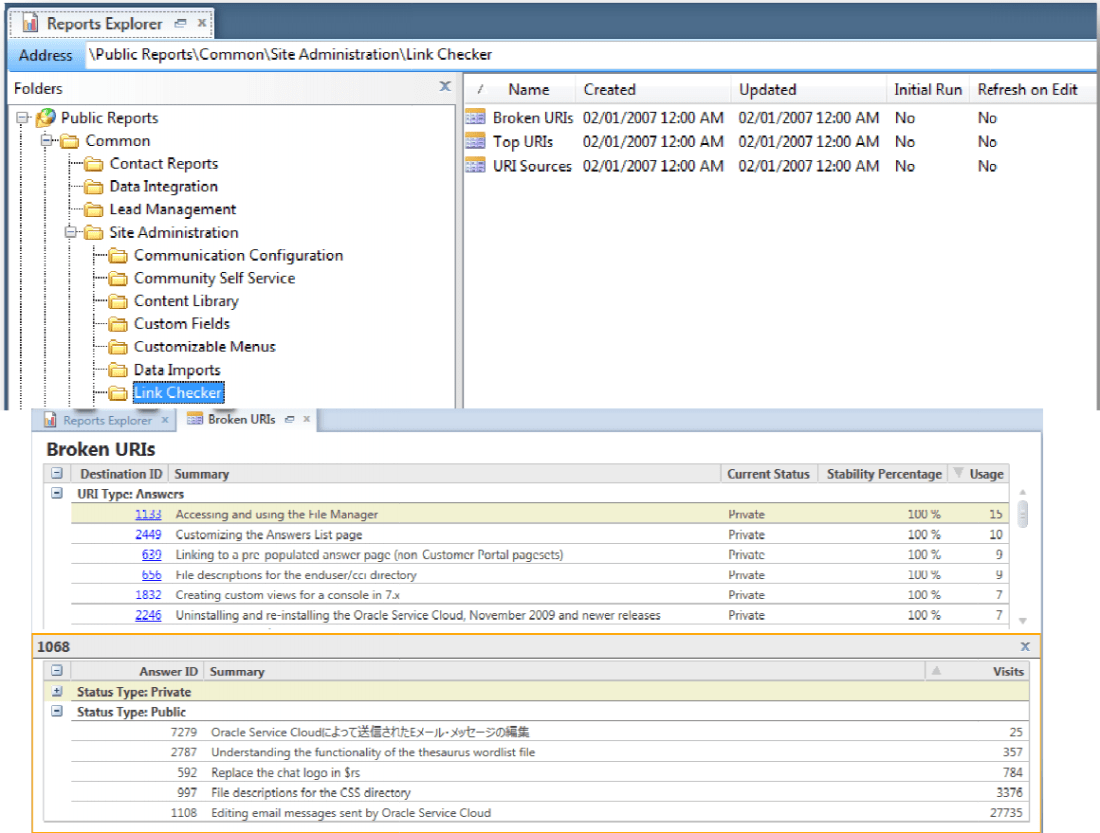
Finally, in this new release, the Site Wide Link Checker (which was introduced in Nov 2015 release) is now able to check Knowledge Advanced answer links, allowing knowledge managers to easily identify broken links within KB content, and fix them.

Oracle_Service_Cloud_Knowledge_Advanced_Site Wide Link Checker

Oracle Service Cloud Platform

Some exciting news at the platform level. As advanced in the Las Vegas conference, Oracle is releasing the Enterprise Extension Manager which will basically be a release management tool, allowing the export and import of configuration changes and packages between environments and interfaces. This is an extremely useful and long-requested feature, by admins and developers, which is not yet complete and Oracle advises has “controlled availability in May 2017 release“.

The May 2017 release also brings enhancements on data management, including Cloud Auxiliary Storage Service. A scalable data storage that provides real-time read/write functionality for non-operational data.

Lastly, Managed Tables are improved in order to expose and allow access to additional OSvC through RightNow Object Query Language (ROQL). The following managed tables are now available for ROQL queries:

  • ChatQueue
  • Flow
  • FlowQuestion
  • IncidentQueue
  • Profile

If you want to know more about May 2017 release and access the release documentation, please visit the Customer Success Blog

What happens in Vegas, needs to be shared

Last week I was in Las Vegas, for the second year in a row, representing Capventis at the Modern Customer Experience conference organised by Oracle. Once more, it was great to have the opportunity to hear from, share with, and meet so many thought leaders, innovators and industry specialists. A fantastic event, really worth attending, with great key notes, sessions and hands-on workshops.

Oracle Service Cloud Focus

My focus was on the Modern Service Experience (MSE) track and Oracle Service Cloud (OSvC), starting very early in the morning of the first day, with a deep dive workshop “Supercharge your Agents – A Guide to Advanced Desktop Automation” where the Product Development team shared some tips and tricks around automating processes using workspace rules, JavaScript API, Agent Scripts and Desktop Workflows.

From that moment until the end of the conference it was 3 days with back-to-back meetings and sessions. The MSE agenda had plenty other great hands-on workshops, with beginner and advanced sessions around extensions and APIs, analytics or customer portal. The Oracle Product Management and Product Development teams shared, in several breakout sessions, not only insight but some great news re. the product strategic direction and roadmap. And roundtable discussions, as well as “fireside” chats, were also very popular and insightful.

Customer Success Stories

One of the highlights of this conference are the sessions where Oracle customers share their stories, and the ways they are using technology as an enabler, to innovate, become more efficient, and thus more successful. Two great examples were presented by Kohl’s and Toshiba Medical Systems (TMS). Both companies implemented OSvC, to transform a vision and desire to improve customer service and experience into reality.

Asked about the reasons to have chosen OSvC, Sebastiaan Dammann, Senior Business Consultant at TMS, said… “Cloud. Easier to collaborate across value chain, and increase CX (…) Completeness of vision. CX, Field Service, planning, back-office (…) Highly configurable and flexible solution. Support Vanilla approach”.

Oracle Service Cloud Roadmap

The most interesting news (at least for us OSvC advocates) always come from the roadmap sessions. And there were some great news shared by the Product Management team. As usual it was all subject to the Safe Harbour Statement, but here it is…

  • The Aug 2017 release will include significant changes to the Business Rules, with a new interface, and enhanced engine to support custom objects (meaning that you don’t need to write code to create automation in custom objects).
  • After the WeChat integration, available since Feb 2017 release, Oracle will publish the Facebook Messenger integration, in the Aug 2017 release (allowing customers to chat / text with agents via that Facebook facility/app).
  • Video chat will also be released in Aug 2017, even though it will only be available for companies in the USA (first agent-side video will be available with customer-side video being introduced at a later stage).
  • Oracle will release a release manager, with versioning capability. An absolute game-changer for administrators and developers, allowing to package configurations/customisations from one interface/instance to export/import into another interface/instance (avoiding the need to re-key or manually replicate configurations). The Aug 2017 release will include a limited number of components (e.g. workspaces, reports) and others will become available over the next few releases.
  • External data virtualisation is also something that Oracle is working on and preparing to make available in the next few releases. It will use Odata and Open API Initiative, enabling custom objects to have reference to external data, allowing the surfacing and/or virtualisation of external data within OSvC.

A big investment and development effort has been put into the Browser UI (BUI) and its Extensibility Framework, where Oracle is hoping to have the majority of agent-facing functionality (currently available in the Dynamic Agent Desktop – .NET console) by the end of 2017.

The BUI Extensibility Framework will enable automation, integration and extension of the BUI. And the next few releases will make available the following extensibility types…

  • Console – e.g. extension areas on Global or Sidebars (e.g. CTI media-bars); additional widgets on Status Bar; new items on Main Menu; modal and pop-up windows.
  • Workspace – e.g. buttons that trigger actions (e.g. set fields), rules or integrations; browser extensions to show other web-based applications.
  • Analytics – e.g. define virtual schemas and tables to display data from external systems, and allow read and write.

The add-in manager, as well as the add-ins area in the workspace designer, will have a specific section for BUI extensions and add-ins, alongside the one currently available for DAD add-ins.

If you are already excited about it, and feel like jumping straight onto it, know that the BUI Extensibility Framework requires knowledge on the below technologies, and that answer id 5169 is available on the community with documentation.

  • JavaScript
  • HTML
  • CSS
  • JSON

All Stars and Heros

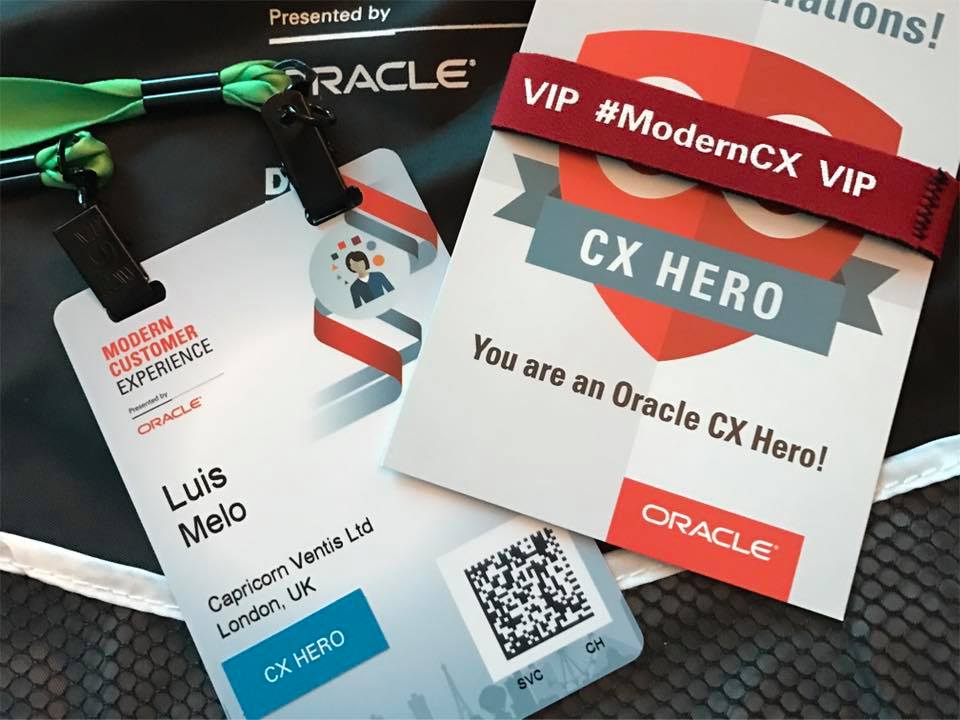
But the icing on the cake, at this year’s conference, was the OSvC All Star and CX Hero status, areas and activities (see photo below)…

  • The Hero Hub booth, where we were able to hang-out with other OSvC heroes, join the Justice League of Customer Service, and have some fun.
  • The CX Hero Lounge, where we could meet fellow CX advocates, do some work during breaks, as well as relax and have a bite to eat.
  • The All Star Appreciation Event, where we got together with the OSvC crew, for some drinks, food and great conversations.

A big thank you to: Keith McFarlane, Stephen Fioretti, Shon Wedde, Jens Lundell, Jeff Wartgow, Vimal Chopra, Susie Boyer, Kent Swartz and Daniel Foppen.

And a very special mention and huge thank you to Erica Leep and Danette Beal for organising all of this, for being absolutely tireless, and for spoiling us with treats.

MSE17_DoctorCX.png

I’m already looking forward to next year’s conference!

Southwest Airline’s fame is well deserved

southwest

I was looking forward to our holiday in California, and to participate in the Modern Customer Experience conference, in Las Vegas. For all sorts of (obvious) reasons. One of them was that I booked two flights with Southwest Airlines (SFO > LAS, and LAS > LAX).

For those who don’t know Southwest Airlines is mentioned as an example, and a success, in several Customer Experience books. It is recognised to be the best airline in the world, when it comes to Customer Service, Experience and Loyalty.

The Airlines’s advocates love it so much that in 2001, after the terrorist attacks in the World Trade Centre, Southwest received thousands of letters from customers who wanted to make sure the company would stay in business. Many of those customers sent checks with the letters. Others returned traveller vouchers.

I had no doubt that the experience was going to be good, but I wanted to experience more. I wanted to experience Southwest in action when things go wrong. To prove that what I read in the books was true. But what if all went well with our flights and travels? Well, the truth is it didn’t really…

When trying to check-in to the SFO > LAS flight, via the mobile app, it said my reservation was cancelled. So I reached out to Southwest via Twitter, on our way to the airport. The response came back in 27 mins. And 5 mins later, after I provided my booking reference via DM, Jennifer had checked us in, even before we got to the airport.

One week later we got to the airport 4 hours before our 15:40 LAS > LAX flight, so I asked at the check-in desk how much would it cost to go in an earlier flight… “Your flight to LAX is delayed 20 mins so I will put you in the stand-by list for the 12:55 flight free of charge. If that one is full you will be also on the stand-by list for the 13:55 flight”. We were called to the 12:55 flight.

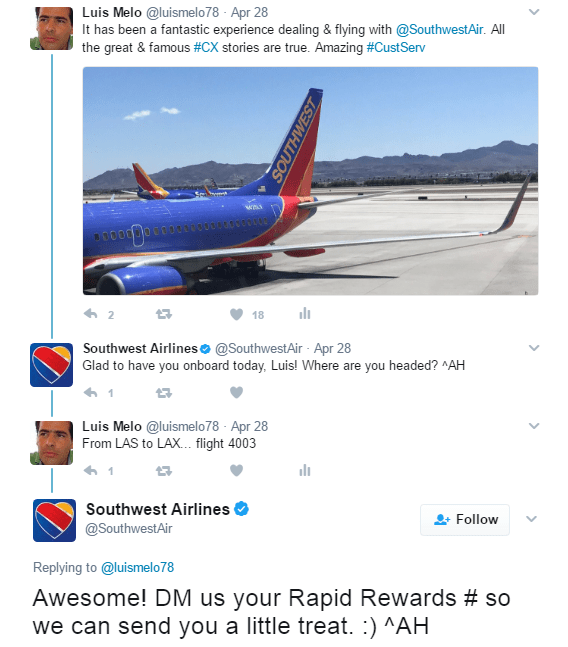
We were truly delighted with the customer service, and I decided to praise Southwest on Twitter, whilst I was at the gate. In a matter of minutes, Adam replied back, asked which was our flight, and gave us a treat (a code for free WiFi on the flight), even before take-off.

southwest_twitter.png

So… the stories are true, and Southwest’s fame is indeed deserved. As they seem to have a big focus on the customer, the experience they deliver, and the service they provide. And the good thing is that some times it doesn’t take much. Small and subtle things make the Customer Experience great. Some good examples below, related to our experience.

Southwest doesn’t try to make (what in CX terms we call) “bad profit“. Each passenger is allowed two pieces of checked luggage free of charge (up to 50 pounds), and a carry-on bag plus a personal item (e.g. backpack, purse). And, if for some reason (even when it is not their fault) there is a delay in a flight, they pro-actively put passengers in earlier flights (or in stand-by lists) free of charge.

Southwest operates as a whole when it comes to customer service. They decided to be there, immediately responsive, on the channel that is most convenient to the client, and they decided to trust the customer, removing all the policies and barriers, resolving issues within minutes, without hassling with too many questions. Moreover, they decided to empower their staff, letting them decide when and where to give goodwill and turn customers into advocates.

Modern Customer Experience 2017 kick-off

The “Modern Customer Experience 2017” event has started in Las Vegas, at the Mandalay Bay Resort and Casino, and I’m looking forward to meet all the CX and Oracle Service Cloud specialists, advocates and heros… as well as to attend a number of fantastic workshops and sessions (my agenda is full, and I’m not able to go to all the sessions I wanted!). I will be there the whole week representing Capventis, so feel free to reach out if you want to meet up.

18118965_10154530191326914_5784131045646337573_n

10 easy things BT could do to improve CX

As many other customers of BT (British Telecom), I subscribed a fibre package that includes voice, broadband, and TV. I also enabled direct debit, and opted out of paper or even email bill. The only thing I get is a monthly notification that my bill is issued and ready to view online. Normally I check the value (if it is what was agreed) and leave it. But in the last couple of months noticed the value increased by £15, so decided to check the bill, which, as you would expect (but not accept these days) was indecipherable. So contacted BT to ask for clarification.

My preferred channel is Live Chat, so I requested a chat session. The chat launch form asked me for Name, Phone Number, Email Address and Topic of Enquiry. Customer Service agent Naveen greeted me, asked me for my account number, and after I asked if he could clarify my bill, dropped me a whole load of pre-formatted messages with generic links to policy and communication documents about fee increases.

1. Why would BT ask customers for Name, Phone Number and Email Address on the chat launch form, if that doesn’t help the agent identify customer accounts, requires agent to ask again, and increases customer effort by forcing customer to repeat information already provided?

2. Why would BT guide its customer service agents to flood customer’s with pre-formatted blurb and generic links to policy documentation, on a Live Chat session, which is supposed to be a 1-to-1 personalised conversation?

I thanked Naveen for the information but said it didn’t help me, nor was it related to my question. I didn’t want a reason for the increase, but rather a clarification on my bill, products and services included, and associated fees. He started by saying that I should not “look at the left side of the bill” as that was only “for BT’s reference“. Then started going in circles. It was clear that not even him could understand or clarify my bill.

3. Why would BT put on a customer bill, information and description which is confusing and not for customer’s reference or understanding?

4. Why would BT make billing processes, and bills themselves, so difficult that not even their trained customer service agents dealing with billing enquiries can understand, or are able to clarify a simple enquiry re. service fees?

Naveen asked if he could call me, saying it would be “easier said than written“. But before he called, asked me if by any chance I had another account, and if I could provide my phone number.

5. Why would BT not give their customer service agents the necessary (crucial!) 360-degree view of the customer, avoiding them having to ask the customer for information that they, themselves, should have in the first place?

6. Why would BT ask for a phone number on the chat launch form, if that information is not even passed to the customer service agent, forcing him to ask the same question again, and the customer to repeat information already provided?

The call only lasted a few seconds. Naveen asked me to close the chat session first, and informed me that he was transferring me to the billing department. I got transferred to a line and… got an automated voice message saying the line was only open on weekdays (it was Sunday!). I wasn’t sure if Naveen was sloppy or trying to be clever.

I requested another chat session. Surprise, surprise!… got routed to Naveen again. Could not help asking him if he knew the line was closed (he must have known!). Initially he denied saying that the called dropped, and after I confronted him, saying that I heard the automated voice message, he accepted it was closed (i.e. he lied at first) and started going around saying he was confused by the change of the hour to summer time!

7. Why would BT not teach its customer service agents to be honest and transparent? To acknowledge an error and apologise? To straight away say sorry and positively offer themselves to resolve the situation?

Naveen asked if he could call again, and on the phone said he was going to talk to the billing department and call me back in 10 mins. I rejected the offer. After all the billing department was closed on Sundays, right?! I sensed he was again trying to get rid of me, again. So I said I would be happy to wait whilst he transferred me.

A few minutes went on with Naveen trying to convince me he would call back “I promise sir, you have my word“. And me saying I would be glad to wait for 10 mins, until he transferred me. Running out of options he said I was not understanding what he was saying, and threw “this is your last chance“. I didn’t understand if it was a threat or something else, but because it seemed to be the end-of-the-line, I asked to speak to his supervisor.

Naveen’s response was as funny as it was stupid “it is useless to talk to my supervisor as he is equally trained“. I said that was irrelevant – even though sad, if true – and demanded to talk to the supervisor. After resisting for a bit, he finally accepted, asked me to hold on the line whilst he transferred me, and… hang up the phone.

8. Why would BT not have pre-defined processes and guides, specifically for these steps in the journey where there might be disruption (e.g. billing department closed on weekends, and front-line agent not able to resolve customer’s enquiry), which would help a customer service agent push back a customer, without hurting the customer experience?

I contacted BT for the third time in 60 minutes, after Naveen got rid of me twice. Got through to Krunal, a customer service agent who wasn’t able to explain my bill, but told me I was up for contract renewal, which would give me a £10 discount on my final bill – but not without, again, asking me for phone and account number, as well as name.

9. Why would BT not pro-actively contact customers who are up for renewal and eligible for offers or promotions, which would make them pay less, be more satisfied, trust BT, and keep being loyal to the company?

I’m happy with the broadband and TV service, so I renewed. But asked Krunal to open a complaint re. Naveen. Told him the whole story and got surprised with his response: “Maybe he is having a bad day today!!“. If it wasn’t for Krunal being helpful and swift re. the contract and offering, I would have been annoyed with the response. But it was enough already, so I left it there and only asked feedback on action taken re. complaint.

10. Why would BT allow their reputation and brand be hurt by a (definitely) young, inexperienced and scared customer service agent, when all he needed was some guidance and training on how to deal with billing queries (which are always complex and sensitive); a system that would give him a full view of the customer, information and knowledge; and a process (and procedures) that would empower him to make decisions, take actions and resolve customer’s queries?

With the setup that BT seems to have, its customer service agents are helpless and get frustrated, by not being able to resolve customers queries, having to jump from silo to departments, and ending up delivering a fragmented, bad and strenuous experience.

Configuration Settings – Tips IV

Oracle Service Cloud has circa 500 configuration settings, which control the platform’s functions. Some of them are commonly used but many are not that well known. Below are a few that you might want to be aware of.

EGW_SAVE_ORIG_MESSAGE

Some of you may have noticed (and found strange!) that attachments with name raw_message.mht appear on your incidents. Even stranger is that most times you are not even able to open it. This attachment is the original email message.

OSvC_raw_message

The EGW_SAVE_ORIG_MESSAGE configuration setting, enabled by default, makes the Email Gateway (incoming email) attach the original email message to the incident, after it is created. If you don’t want or need the original message attached, set this configuration setting to “No”.

Please also notice that subsequent updates (via email) to the same incident will not be saved as attachments or update the original file.

The raw_message.mht is in MIME HTML file format. If you have a compatible application to open this type of file, it will open in browser window, and the message will display in html (or text) format. You can also download the raw_message.mht file to your Desktop and “Open With” a text editor, to see the raw message, which will contain e.g. the original Internet Email headers.

ANS_PRV_ENABLED

This configuration setting enabled the Privileged Access feature of OSvC, which is what allows customers, in the customer portal, to see specific answers or content that is limited by Answer Access Levels.

By default, this configuration setting is disabled, and you need to enable it if you are creating different answer access levels (and associating it to SLAs), in order to give your customers different or more answers, or even additional content in the same answers (via conditional sections).

SA_APPEND_QUESTION

Most of you already noticed that when you add an answer as text to an incident (when using the “Add as Text” option on Search Knowledge Base or SmartAssistant windows), by default you add the Summary, the Question and the Answer.

This configuration setting, which is enabled by default, is what causes the above behaviour. If you want to remove the Summary and the Question sections and only add the Answer to your response, you need to disable it.

OSvC_answer_add_as_text


8 attributes of customer-adaptive enterprise

Ovum, the London-based independent analyst and consultancy firm, which specialises in global IT and telecomms, recently published a study on D+M Group.

On that study Ovum tags D+M as a “customer-adaptive enterprise“, identifies and examines the 8 attributes that “create the right conditions for rapid adaptation to ensure persistent customer relevance“.

I recommend you to read the study, which you can find here (PDF), and to open your appetite I share below some of the more interesting statements, as well as the info-graphic with the 8 attributes.

ovum_8_attributes_customer_adaptive_enterprise

“New CEO and turnaround specialist, Jim Caudill, who had been instrumental at Black & Decker (…) hired a team of largely former B&D executives to get the much-needed transformation under way with the aim to grow the company profitably“.

Ovum argues that to thrive in an age of rapid and accelerating change and in a global economic environment where growth is hard to come by, firms must develop the ability to sense, respond to, and adapt to change, particularly that which impacts customers and their buying behaviours, expectations, wants, and needs. As cycle times for adaptation continue to shorten, it puts enormous stress on enterprises often held back by legacy systems, processes, and departmental silos. These companies will fail to adapt at the right speed“.

The core question behind Ovum’s customer-adaptive enterprise research over the last four years has been to determine what it takes for any enterprise to remain persistently relevant to its customers. The term customer relevance was barely mentioned four years ago, but the message that customer relevance must be at the heart of any growth strategy is finally beginning to cut through management thinking“.

“Our research has shown that flying a business on one engine can be fatal. What happened to Nokia and BlackBerry when Apple entered and dramatically changed the smartphone industry, followed rapidly by Samsung, should provide a salutary lesson“.

Other business leaders have focused attention on shareholder value, but to paraphrase Jack Welch, former CEO of GE, that is one of the dumbest ideas, as shareholder value is an effect, not a cause, of growth”.

“To thrive and maintain customer relevance, any firm must not only deliver a positive customer experience at every opportunity but also create, deliver, and refresh value as perceived by customers on a continuous basis. This demands the ability to understand customers deeply and innovate on a continuous basis“.

“The twin engines of growth – customer experience and continuous innovation – are not departmental challenges, as they have implications for the entire enterprise, its ecosystem of partners, suppliers, and most of all its customers. It’s the CEO’s job to create the conditions where both engines are firing on all cylinders, something that Caudill, aided by his leadership team, has managed to do“.

Good to notice that D+M chose Oracle CX Cloud Suite as their foundation customer engagement platform – including Oracle Customer Data Management (CDM), Oracle Sales Cloud, Oracle Social Cloud, Oracle Marketing Cloud, and of course Oracle Service Cloud “to provide an integrated environment to support teamwork across each functional area and meet all the criteria necessary to create a unified foundation for a more modern and customer-oriented cross-channel engagement capability“.

You can also watch D+M CIO, Scott Strickland, sharing how the company leveraged Oracle CX Cloud products globally to transform the customer experience.

Let’s meet up in Las Vegas again!

moderncxLasVegas.png

Only 4 weeks to go for Oracle’s Modern Customer Experience conference. For the third year in a row, this fantastic event – where 3,000 attendees network, learn and share experiences – is going to happen in Las Vegas.

The conference has 4 main tracks: Commerce, Marketing, Sales, and Service. The latter is all focused around Oracle Service Cloud and what the platform can do to enable business transformation and deliver better customer experience.

As always, there will be different events to attend and things to do:

  • Sessions where Oracle’s customers share success stories. How they implemented and use Oracle Service Cloud. What they did to differentiate themselves and innovate. And what business results they achieved.
  • Sessions where special guests share thought leadership. Business leaders, research analysis, subject matter experts and Oracle Product Managers will share forward-thinking ideas, trends, drivers and a vision for the future.
  • 1-to-1 “Ask the Expert” sessions. A great opportunity to discuss with Oracle experts, and get the answer to particular questions or guidance to resolve any challenges that might be specific to your business.
  • Demos in the show room. Oracle and some partners will be showing Oracle Service Cloud and it’s new and more relevant features. As well as showcase scenarios where Oracle Service Cloud was or is being used to improve business performance.

I will be in Las Vegas, and look forward to meet all the specialists, experts, advocates and enthusiasts of Oracle Service Cloud.

I will also be available to meet anyone that would like to share an experience or ask any question. So if you would like to meet up, please request a meeting here, and I will be more than happy to arrange a face-to-face, where we can chat over a break, a coffee or drink.

The Justice League of Customer Service

aFVwiFi.jpg

Most of us, in particular those that have been implementing these type of applications in the last decade or two, know that the Oracle Service Cloud community is one of the best communities of its kind.

It is easy to use, full of useful content, and supported by a fantastic team that has a massive focus on those who seek help and/or provide insight, on the Oracle Service Cloud platform (spanning through RightNow, OPA, Field Service or Knowledge Advanced).

But usually we go to the community when we bump into a challenge or a problem. The community is a safe harbour for us to ask for guidance, support or help to resolve our issues.

The truth is that currently, more than be reactive and sort out issues that come up, we need to be pro-active and also find ways to innovate, in order to “fix” things before they even happen, to ultimately provide a better experience to our customers and staff.

That was one of the reasons why the Oracle Service Cloud team created the Oracle Service Cloud Hero Hub, where we can not only learn more about Oracle Service Cloud, but also have fun doing it.

I would strongly recommend that those of you who are working with Oracle Service Cloud, join the Hero Hub, and take part of this “Justice League of Customer Service“. To know more about the Hero Hub, and to learn how to join, check out Erica Leep’s post: Calling Customer Service Heroes to the Oracle Service Cloud.