Versioning of Answers with VersionCX from Ideqa

Oracle Open World 2014 was very fruitful to me. From an Oracle Service Cloud perspective, it was really great. a) I had the chance to confirm some of the great features and functionalities in the roadmap, and b) I was able to get in touch with people/companies that work everyday to improve the customer and user experience of those who interact with Oracle Service Cloud.

One of those companies is Ideqa. A New Zealand-based company, that focuses on CX and partners with Oracle for the implementation of Oracle Service Cloud. But they were not satisfied with what the product had to offer, and went on to build a very clever functionality: VersionCX, which helps companies manage versioning of Answers in the Knowledge Base.

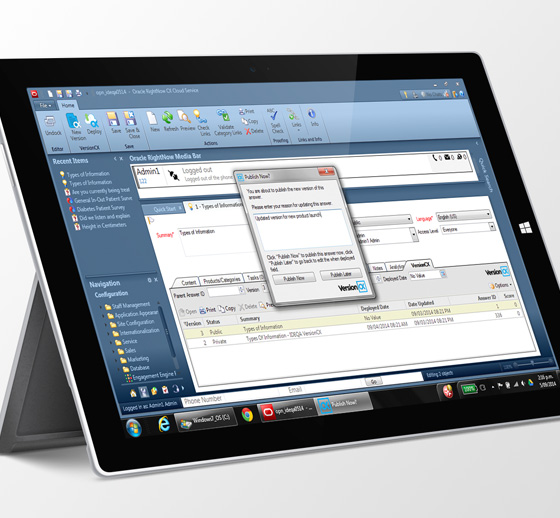
VersionCX is an add-in for Oracle Service Cloud that allows companies to store historical versions of Answers. This will allow knowledge managers to consult or roll back to prior versions if necessary (for business or even legal reasons). VersionCX also allows the scheduling of Answers.

But the coolest thing about VersionCX is that the new/updated version of the Answer always takes the original ID, which means that a) the Answer retains its score and historical usage, and b) ensure the embedded URLs and Google searches continue to return the correct result.

VersionCX-Image

To know more about VersionCX (prices, packs) visit Ideqa’s website.

Kodak faced 3 challenges and chose Oracle Service Cloud

Kodak is one of the most well know companies in the world, when it comes to imaging solutions. Over the years, Kodak has acquired a number of other companies. This was a big challenges with regards to the way they serviced their customers. Mainly because all these businesses they acquired used different systems and ways of servicing their customers. Kodak needed standardisation and consolidation, alongside capability and scalability.

Challenge #1 – To have a 360-degree view of the customer
Kodak “did not have an enterprise-wide view of its customers“. Kodak needed “to standardize its customer relationship management (CRM) environment across its business-to-business (B2B) operations

Challenge #2 – Consolidate knowledge across the business
Each business that Kodak acquired had “its own service system and knowledge base“. Kodak “wanted to globally consolidate knowledge that resided in more than 40 distinct knowledge bases“.

Challenge #3 – Choose an omni-channel and future proof system
Kodak was looking for a system that would allow the company “to understand how to best serve its customers, manage interactions consistently across all channels, seamlessly transitioning from self service to assisted service when necessary“.

Kodak chose an Oracle solution to address these challenges. Oracle Service Cloud is now the main customer service and customer-facing solution for “Incident Management, Knowledge and Web Deployment“, integrated with the back-office system, SAP, that manages service contracts and entitlements.

See Kodak’s Web Self-Service Portal, deployed by Oracle Service Cloud
See Kodak’s success story on Oracle’s website

The IT System as an scapegoat

Customers with complaints about their gas or electricity service typically have to contact their supplier 6 times before their issue is resolved

A report from the Office of Gas and Electricity Markets (OFGEM), that regulates the electricity and gas markets in Great Britain, says that “57% of customers who had complained were not satisfied with the response“.

OFGEM’s CEO, Dermot Nolan, said that the research findings were “frankly awful” and approached the energy company bosses demanding an audit to their complaint handling processes, and improvements in their Customer Service, by being proactive, better communicate and quicker in response.

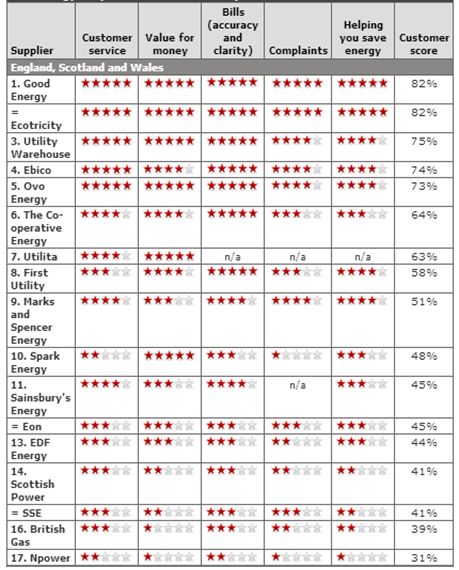
Customer satisfaction was particularly low with Npower and Scottish Power, who blamed the installation of a new IT system, saying that the transition had been “challenging” and claimed to have recruited more than 250 extra staff to deal with the problems.

Now this is something interesting: a) The report’s findings are not breaking news. Energy sector companies have been laggards when it comes to Customer Experience, and the results are out there – see image below; b) The excuse used by that Scottish Power is recurrent. Given by internal Managers to the Board, and by the Board to the public.

I truly believe that Scottish Power – as well as all the other companies that try to improve their Customer Experience by the introduction of new technology – face a real challenge. But it’s so easy to blame the “IT System” because it is not a person and cannot defend itself.

As a Consultant, specialised in Customer Management (CRM/CX) solutions and working with companies to implement those, I ask: What about the people that chose and bought the “IT system”? The people who designed and managed its implementation? The people who actually implemented it? The people that planned and managed the change?

“IT System” implementation failures are common. But it’s not the “IT System” fault, is people’s fault! Because people forget to focus on Customer and User Experience. Because people forget to put themselves on the shoes of the customer, and analyse his/her journey, in order to have an outside-in perspective of their internal processes and procedures.

Because people forget that such a project should be owned, led and managed by the business (not by the IT department), and implemented with the business. Because people forget to start by the desired outcomes and get it wrong when it comes to scoping. Because people assume that the project has to be big, long and complex, with a big-bang deployment.

Because people build an “IT System” rather than a “Business Solution”. Because people try to adapt their business to the technology, and not the other way around. Because people try to shove all siloed departments into a monster “IT System”, rather than having a broader and strategic approach, re-designing processes and changing the way they do things.

Technology and IT Systems are the best way to improve Customer Experience. They can enable omni-channel, quick, consistent and proactive communications. They can provide a 360-degree view of the customer. They can offer an end-to-end view of the customer journey. But they need to be handled with care, by people who have the right knowledge, experience, specialism and skills.

energy_companies

Oracle Service Cloud with LinguistNow, by iRobot

iRobot was founded in 1990 by MIT roboticists. The company designs and builds robots for home usage, like vacuum cleaner, floor scrubbing, floor mopping. iRobot has a $500 million revenue, 500+ employees, and sold more than 6 million robots in 60 countries.

Customer Service is very important to iRobot. To manage that, and engage with their customers, iRobot implemented Oracle Service Cloud. The Oracle Service Cloud Customer Portal and Knowledge Base are behind one of the key parts of customer service, web self-service.

iRobot has 6,000 FAQs in the Oracle Service Cloud Knowledge Base and the need to translate and organise them all in order to better serve non-English speaking clients around the world. That was obviously a massive task for a company which core business is robots, rather than translation.

After consulting Oracle iRobot went to Language I/O and implemented their LinguistNow Help product, which seamlessly integrate with Oracle Service Cloud (integration validated by Oracle) in order to translate all the answers/articles in the Oracle Service Cloud Knowledge Base.

Over one year ago I wrote a post about this great product. Today, I share the below video. It is a webinar where iRobot gives their testimony regarding the Oracle Service Cloud / LinguistNow power.

Customer Support in any language from Language I/O on Vimeo.

Oracle Service Cloud Roadmap

The usual quarterly releases have brought many great improvements to Oracle Service Cloud, in terms of functionality enhancements or new features. But there is still more to come in the next releases. The Oracle roadmap for Oracle Service Cloud has a lot of new stuff for the coming 12-18 months, of which I highlight:

Virtual Assistant

  • Enhancements to the VA will improve the conversation. More than being able to chat with the customer, the VA will suggest questions & answers based on the web visit.
  • A tighter integration between both products – Oracle Service Cloud and Oracle Virtual Assistant (formerly known as Intent Guide) – will make it easier to integrate and will allow shared admin (currently, to configure VA admins have to use different UI / login).
  • VA will be available to be used in any web page, by the use of a Syndicated widget. Currently it can only be used in Oracle Service Cloud Customer Portal pages.

Community

  • A tighter integration between both products – Oracle Service Cloud and Oracle Service Cloud Community – will allow shared admin (currently, to configure Communities admins have to use different UI / login).
  • Oracle Service Cloud and Oracle Service Cloud Community will use the same structure (taxonomy), which means that answers in the Knowledge Base and in the Community forums will have same categorisation. This will improve search results.
  • The communities (Support and Innovation) will be available not only in the Oracle Service Cloud web Customer Portal but also for mobile devices.

Syndicated Widgets

  • To add to the current Chat (re and proactive), Knowledge and Surveys widgets, more syndication widgets will be made available for social, incident management, polling, etc.
  • These new widgets will also bring more power to the developers and admins, offering more control in terms of when and how widgets display.
  • Last but not least, developers will have the possibility to create Custom Syndicated Widgets, in order to create business-specific / requirement-specific widgets to be used outside the Oracle Service Cloud Customer Portal.

Skills Based Assignment

  • The May 2014 release of Oracle Service Cloud brought this great new feature, that applied to the incidents coming from the Chat channel, making it possible to route incoming chats to agents based on their specific language, product skills and workload. In the roadmap Oracle states the intention to expand this feature to other channels.

Oracle Social Network

  • The August  2014 release introduced internal collaboration by integrating Oracle Social Network (OSN) with Oracle Service Cloud. In the roadmap is enhances functionality that will allow prioritised incident collaboration, and expert locator (based in categorisation), as well as make this available on mobile devices.

Dynamic Agent Desktop

  • The greatest and more pressing (in my opinion) thing is also in the roadmap and everyone is looking forward to have it. It is the new browser UI (i.e. the Dynamic Agent Desktop thin client). According to Oracle it will work in any platform and browser (Chrome, Firefox, IE, Safari).

August 2014 Release is now available

The August 2014 release of Oracle Service Cloud (formerly known RightNow CX) is now available. This time there’s nothing extremely exciting but it brings some considerable changes and very useful features.

First and foremost, the platform is no longer called “RightNow CX”. Oracle officially renamed it to “Oracle Service Cloud. You might have noticed that I’ve been doing that for the last few weeks, and already change the labels in the blog.

Oracle Social Network – Collaboration
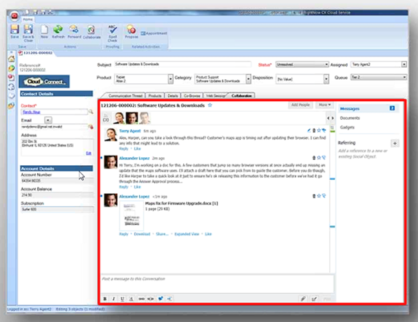
To increase (internal) collaboration Oracle has integrated Oracle Social Network (OSN) with Oracle Service Cloud. From within the Agent Desktop, in the Incidents workspace, agents will have a button on the ribbon that will open a window with a list of their peers. The conversation can take place in the “Collaboration” tab and include multiple agents.

5_collaboration chat

Chat – Routing Rules
Chat routing rules was improved to make sure that chat requests are always routed to the agent that has the fewest number of active chat sessions. This will not only balance (even more) the agent’s workload but also decrease the customer waiting time.

Custom Objects – Limitations
Menu-only objects (created to populate menu options in menu-type fields in Custom Objects) will no longer be included in the limitations imposed by Oracle regarding the object designer. This includes not only the limitations in terms of the amount of custom objects in the system but also the limit of 200 objects when deploying and 25 objects when importing.

Surveys – Results by Agent
The new release allows companies to track survey results by agent. The agent assigned to the record at the point of shooting the survey (e.g. incident after chat) will be associated with the survey, which means that reporting can then be filtered by agent with accurate results, even if in the meantime that record was assigned to another agent.

Incident Thread Message – Rich Text
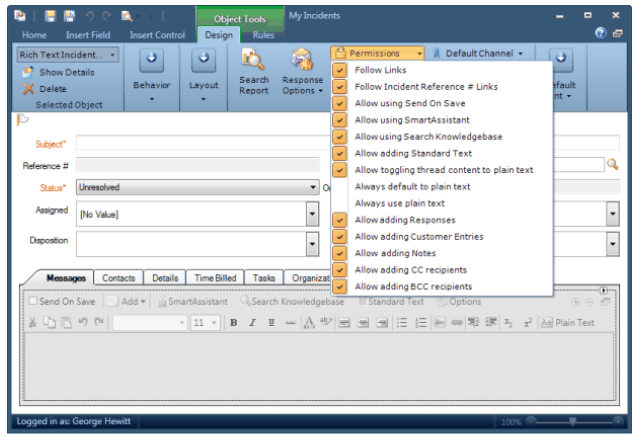
New rich text options are available in the Incident Thread control (used in the Incident workspace). These include a) always default to plain text and b) always use plain text.

1_New rich text incident thread control

Workspace – Wrap control
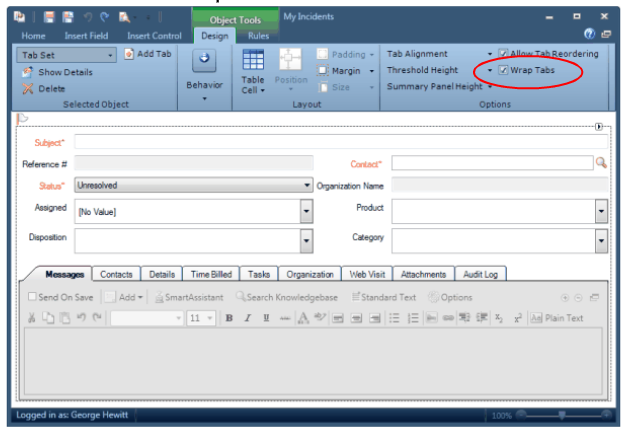
Workspaces will have a new “Wrap” tabs control option that will allow the consultant to determine if the workspace or script tab is going to be displayed across multiple lines or on a single scrollable line.

2_New wrap tabs control option

Cross-site Email Management
A new feature is available to send emails with incident information from one Oracle Service Cloud instance to another – which only makes sense if a company uses more than one instance of Oracle Service Cloud. The only limitation is that both need to be in August 2014 version.

Configuration Settings – IPv6
A considerable list of security-related configuration settings can now support IPv4 and IPv6 addresses. A few examples are the ones who define which hosts are allowed to access the interfaces: SEC_VALID_ADMIN_HOSTS, SEC_VALID_ENDUSER_HOSTS, SEC_VALID_CHAT_API_HOSTS

Customer Portal – Widgets and Custom Objects
Various updates were introduced in this release including increased support for Siebel integration (v. 8.1.1.7) and a new CP Framework version (3.2.3). Changes include updates to various widgets (e.g. ConditionalChatLink, DateInput, SelectionInput, TopicBrowse, FieldDisplay, ResultInfo, SimpleSearch) as well as allow custom objects menu attributes to be used with FormInput and DataDisplay widgets and the rn:field tags for Contact and Incident objects.

API – Connect PHP
The Connect PHP API was extended with the introduction of the public mail API. Using this new API it is possible to bypass internal SMTP mail server and associated whitelisting (legitimate email addresses and IPs) requirements.

Single Sign On – SAML tokens
The new release of Oracle Service Cloud now supports on SAML tokens, additional users information commonly requested by Service Providers.

ROQL – New objects
ROQL was also extended to improve the ability to leverage the Connect Common Object Model in external applications. With the introduction of the SystemInformation sub-object, API consumers can now return data sets up to 100,000 records. The introduction of the ArchiveInformation object (that exposes table delete_recs) will enable the extraction of delete records. DistributionEmailList and DistributionEmailAddress now expose mail_list, mail_addr and mail_list2addr tables, allowing access to information about distributions lists, prevent whitelisting and avoid direct SQL queries.

A future proof Customer Service solution that delivers outstanding CX

A recent Gartner report talks about “Customer Service Predictions” and gives 4 strategic planning assumptions that Gartner thinks must be followed by those companies that want to succeed by delivering an outstanding Customer Experience (CX).

Gartner’s summary is very clear: “Customer service is (…) the core business strategy to create a winning CX. Great service needs to be consistent across all mobile devices, as well as social and digital media channels. It also needs to be personalized (…)“.

The report outlines that in 2 years’ time…

  • Facebook and Twitter will have their own social media engagement applications for enterprise customer service.
  • At least 60% of the Internet users will opt for mobile customer service applications as their first option.
  • 50% of peer-to-peer community offerings will be packaged and sold alongside Web self-service offerings.

Among the key recommendations from Gartner is the need to have C-level buy-in, design a strategy and build the necessary skills/competencies. But obviously this has to be enabled by technology, and Gartner says: “expect best-of-breed software providers to be a key part of this journey

Oracle owns one of the best – if not The Best – technologies in the area of Customer Service. It is called Oracle Service Cloud (formerly RightNow CX), often recognised as a leader in Customer Service solutions for Small, Midsize and Enterprise organisations.

This technology combines web, social and contact centre experiences for a unified, omni-channel solution in the cloud. And it already addresses most of the things that Gartner is now saying that companies should focus on, probably making it the wisest technology choice.

Oracle Service Cloud social features enable organisations to manage social interactions as a fully integrated part of the CX. Companies can use the “Social Cloud” functionality to monitor and engage their customers via social media networks such as Facebook, Twitter, YouTube or Blogs.

From a customer service perspective, Oracle Service Cloud allows a contact centre agent to create an incident (or Service Request) directly from a tweet, a post or a comment, and deal with that customer in his preferred social channel – or take it off-line as and when necessary.

Oracle Service Cloud also has a special Facebook application called “Self-Service for Facebook” that delivers the same exceptional support from other channels right from a Facebook page. And this works both in standard and mobile interfaces.

“Mobile” is another of Gartner’s predictions that Oracle Service Cloud is already prepared to address. The Oracle Service Cloud Customer Portal – that customers use to self-serve, manage accounts or engage with the company – not only provides a superior CX on full-featured browsers, but also includes an out-of-the-box set of pages designed specifically for mobile devices.

The third Gartner prediction is related to peer-to-peer communities. Once more Oracle Service Cloud is a step ahead. It offers community features integrated with its Customer Portal. Actually, it goes even further. It offers two different types of community: Support and Innovation.

The Support Community allows customers to ask questions and find answers in an peer-to-peer-type community, helping themselves and making them feel valued, without adding a single call or email to the company contact centre’s workload (perhaps even lighten it).

The Innovation Community is designed to give customers a voice in the company’s product/service innovation process, so they can help the company identify the new opportunities and bug fixes, or even guide the roadmap, prioritize/refine ideas and develop the next breakthrough.

There is also a very interesting finding in this report. Gartner states that “Many small or midsize businesses (SMBs) and enterprises have still not invested in multichannel customer service strategies and, instead, opt for a conglomeration of point solutions“.

My experience tells me that this is one of the main reasons why many companies strive to deliver a CX that differentiates them from the competition, and allows them to take the leap that will transform the business and make them a solid player in the market.

Oracle Service Cloud is that unified and omni-channel customer service platform that not only addresses today’s challenges and requirements, but is also future proof, offering the features and functionalities that customers are starting to require/expect and will demand in a near future.
Good design leads to outstanding CX

The Comcast-gate is still very much fresh in our memories. Thousands of opinions have been written about it, and shared (I did to – “Aggressive CC agents deliver outrageous CX”). The ones who nailed it are those who didn’t blame the employee, but the way the service model was built by the company.

In one of my latest posts (“You don’t buy customer loyalty… You earn it”) I point out that the delivery of a great Customer Experience is first and foremost dependent on the design of a good model. One that will allow, even the most junior or less apt / capable employee, to deliver an outstanding service.

We all had many bad experiences with contact centre agents. And we obviously got angry with them. The thing is we were calling because we had a problem, and the way we were (mis)treated by the contact centre agent made it even worse. Naturally we blamed it on him, because he is the one dealing with us.

But this is what is happening in the other side of the line: the contact centre agent is looking at three screens and flicking through tens of applications (KB, CRM, ERP, OMS, etc…) trying to find the solution or the answer for our enquiry/issue, regarding that one particular product/service (out of the hundreds his company provides).

When an employee is delivering a poor Customer Experience it is probably not his fault. It is more likely to be because the company set him up to fail. The service model was poorly designed. Sometimes it might have even started well, but the addition of new services, products or channels led to more policies, processes, procedures, systems… which increased the complexity of the job.

Believe me, I have been in many contact centres, and this is what I have seen in most of them. A few years ago I also had the opportunity to be part of a project in a telecom company, where we were building a CRM system for the sales force. The system was so complex that many times I thought “how can an average contact centre agent get his head around this system?

These cases are prolific in Telecom companies, as they provide hundreds of products, services, bundles, etc. There is one American telecom company (not the same I mentioned above) whose system is so complex that it took 12 months for a new employee to be completely proficient. But the truth was most of them left the company after 9 months (one can wonder why!).

The service model design must be good, in order to simplify the job, so that employees focus on the customer and his issue. The design of good IT systems is obviously part of that. A system that is user-friendly and easy-to-use can be swimmingly operated and free employees to focus on the customer and the service they are providing.

A good and well-designed IT system reduces the complexity of the job, and can even eliminate the need for long, intensive and costly training – consequently reducing costs for on-boarding and change management. An intuitive IT system can be operated with almost no experience and enables employees to do their job almost from day one.

Most companies tend to hold off great spending in the implementation of IT systems, dismissing the early design phase and jumping directly into the configuration of the software. They have not yet realised that a good design is exactly what will make the IT system simplify their employees’ job, and hence enable them to deliver an outstanding Customer Experience.

Oracle Service Cloud opens bigger gap with TOA Technologies

Oracle Service Cloud is, in my opinion, the best cloud-based customer service solutions and will now open an even bigger gap to the competition, with the addition of features and functionalities from TOA’s solutions – after Oracle announced the acquisition of TOA Technologies, leader in cloud-based field service solutions.

For some companies, and customers, field service is a critical aspect of customer service…

From a customer perspective, we know how painful it is to be at home waiting for our internet provider’s technician, that never arrives to fix our problem. Or how annoying it is to stay home an entire morning waiting for the delivery service that is due to arrive between 8 AM and 1 PM!

From a company perspective, we know how hard it is to have employees on the road – many of them contractors; delivering products/services; on schedule or responding to unexpected demands – and being able to manage, monitor or communicate with them. Trying to make everything more efficient and cost effective.

TOA Technologies’ solution were built to manage and optimize field services, by coordinating activities between dispatchers, mobile employees and their customers. Enabling real-time monitoring of service requests coming through the contact centre, allowing the routing and assignment of the right employee to dispatch, predicting service windows with accuracy, letting employees on the road collaborate in real-time and communicate with customers via any channel.

The solution seems to be mature and proved. Tagged as the best by Gartner – in the Gartner’s Magic Quadrant for Field Service Management: “TOA is a best-of-breed field service optimization vendor based solely in the cloud” – and used with success in companies like E.ON, Orange, Ricoh, Telefónica, John Lewis, Virgin Media, Bupa or Vodafone.

Gartner Magic Quadrant for Field Customer Service - Oct 2013

TOA stands for “Time of Arrival”, and that should mean everything, for companies and customers. Reduce overtime, miles driven, cancellations and waiting time. Increase job completion rate and customer satisfaction.

Currently, TOA has three main solutions: ETA Direct Professional, ETA Direct Enterprise and ETA Workforce (for salesforce.com users). Let’s wait and see if TOA will remain a separate product or if its functionalities will be completely integrated or immersed in Oracle Service Cloud.

toa1